What Is Local SEO? A Small Business Guide (2026)
By Harsh Rai
Local SEO helps small businesses outrank bigger competitors nearby. Learn the five core ranking factors, common mistakes, and a simple checklist to get found on Google in 2026.
So, what is local SEO? In simple terms, it's the practice of optimizing your online presence so your business shows up when nearby customers search for what you offer: think “plumber near me” or “best bakery in Sector 32.” Unlike regular SEO, which competes for rankings across the entire internet, local SEO competes within a specific geographic radius, which means smaller businesses have a real shot at ranking above much bigger competitors.
If you've ever searched for a business and seen a map with three listings above the regular results, that's the “local pack,” and getting into it is the entire game of local SEO.
Local SEO vs. Regular SEO: What's Actually Different
Regular SEO and local SEO share the same foundation (good content, technical health, backlinks), but they optimize for different signals.
Regular SEO cares about topical authority, content depth, and backlinks from anywhere in the world. A national e-commerce brand competing for “running shoes” is playing this game.
Local SEO cares about proximity, relevance to a specific location, and prominence within that location. A shoe store in Gurugram competing for “running shoes store near me” is playing an entirely different game, one where Google Business Profile, local reviews, and location-specific content matter more than raw backlink volume.
This is why a small business can outrank a national brand locally, even if it has a fraction of the domain authority. Local SEO levels the field.
The Core Pieces of Local SEO
If you strip away the jargon, local SEO comes down to five things:
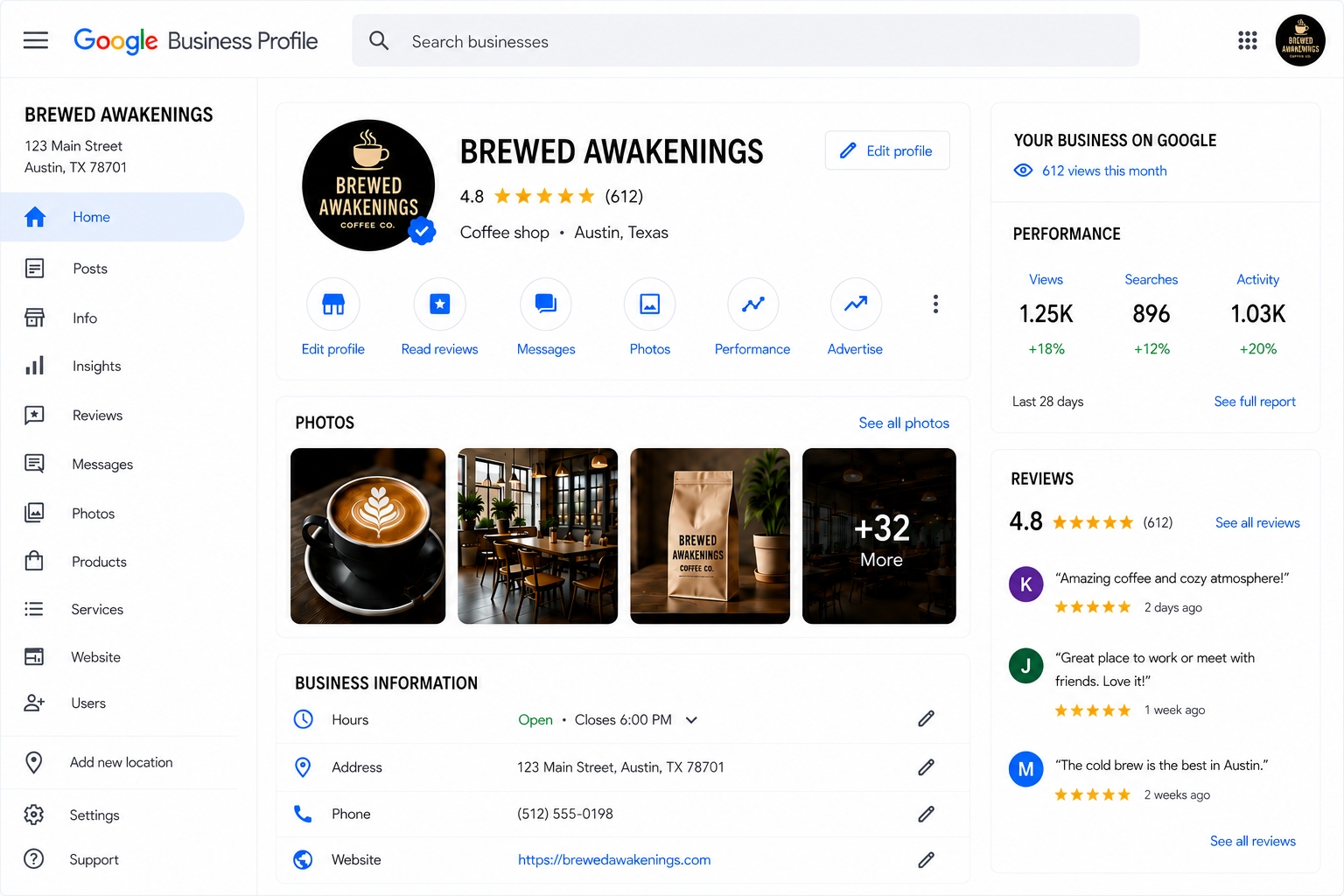
1. Google Business Profile (GBP)
This is your single most important local SEO asset. Google Business Profile signals alone account for roughly 32% of local pack ranking factors, according to BrightLocal's 2026 study, making your profile more influential than your website, backlinks, and citations combined. A fully completed listing, correct category, hours, photos, services, gets up to 7 times more clicks and 70% more in-store visits than an incomplete one, according to Google's own 2026 data.
2. NAP Consistency
NAP stands for Name, Address, Phone number. Google cross-checks your business details across directories (Justdial, Sulekha, your own website, industry listings). Inconsistencies, even something as small as “Sector 32” vs. “Sec-32,” can quietly hurt your local rankings.
3. Reviews and Reputation
Review count, review recency, and your response rate all factor into local rankings. Businesses in the top three local pack positions average 200 or more reviews, according to a 2026 BizIQ analysis, though a smaller number of recent, responded-to reviews can still outperform a larger pile of old, ignored ones.
4. Localized On-Page Content
Your website itself needs to signal location relevance: city and neighborhood mentions in titles, headers, and body copy, plus embedded maps and location-specific service pages if you serve multiple areas.
5. Local Backlinks and Citations
Links and mentions from local business directories, local news, chambers of commerce, and community organizations carry more local-ranking weight than a generic national backlink.
How Often Should You Post on Your Google Business Profile?
Posting isn't optional anymore, it's a ranking signal. Businesses that post to their Google Business Profile weekly gain an average of 2.3 local pack positions over six months compared to businesses that don't post at all, according to 2025 data from Local Falcon. Profiles left untouched for 30 or more days can see their impressions quietly decline.
You don't need to post daily. Once a week is generally enough to keep a profile signaling as active for most small businesses; two to three times a week suits more competitive categories like restaurants or salons. What you post matters less than posting consistently: updates, offers, and photos all count, as long as the profile keeps showing signs of life.
Why Local SEO Matters More Than Ever in 2026
The numbers make the case better than any opinion could:
• Local intent is now nearly half of all search. 46% of all Google searches carry local intent, according to 2026 data compiled by BrightLocal. “Near me” searches specifically have grown by more than 900% over the past two years (Google/Think with Google).
• These searches convert fast. 76% of “near me” searches lead to a store visit within 24 hours. People searching locally aren't browsing; they're deciding.
• AI is now part of local discovery too. 40% of local searches now surface an AI Overview, and Google draws these summaries directly from active Google Business Profiles, according to BrightLocal's 2026 data, which means your GBP listing matters even to people who never click through to your website.
• Most businesses still aren't competing here. Despite all of this, 58% of businesses still don't optimize for local search at all (Digital Applied, 2026), which means the opportunity is still wide open for the businesses that do.
5 Common Local SEO Mistakes Small Businesses Make
• Leaving Google Business Profile half-filled out: missing categories, no photos, outdated hours.
• Inconsistent business details across directories: different phone numbers or address formats confuse both users and Google.
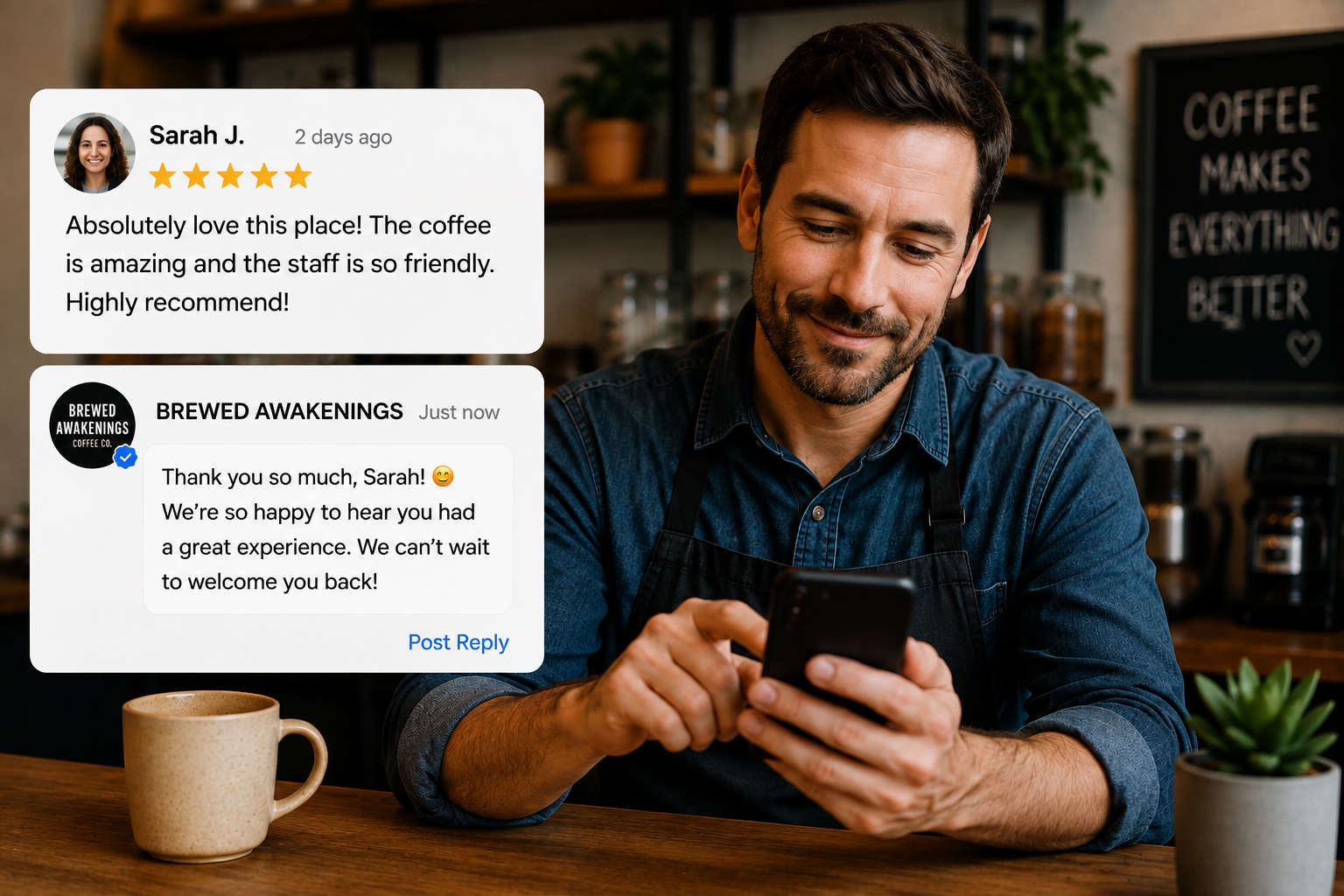
• Ignoring reviews: not asking for them, not responding to negative ones.
• Generic website copy with no location signals: a homepage that never mentions the city or neighborhood it serves.
• Treating local SEO as a one-time setup instead of an ongoing process: GBP posts, review responses, and citation audits need regular attention.
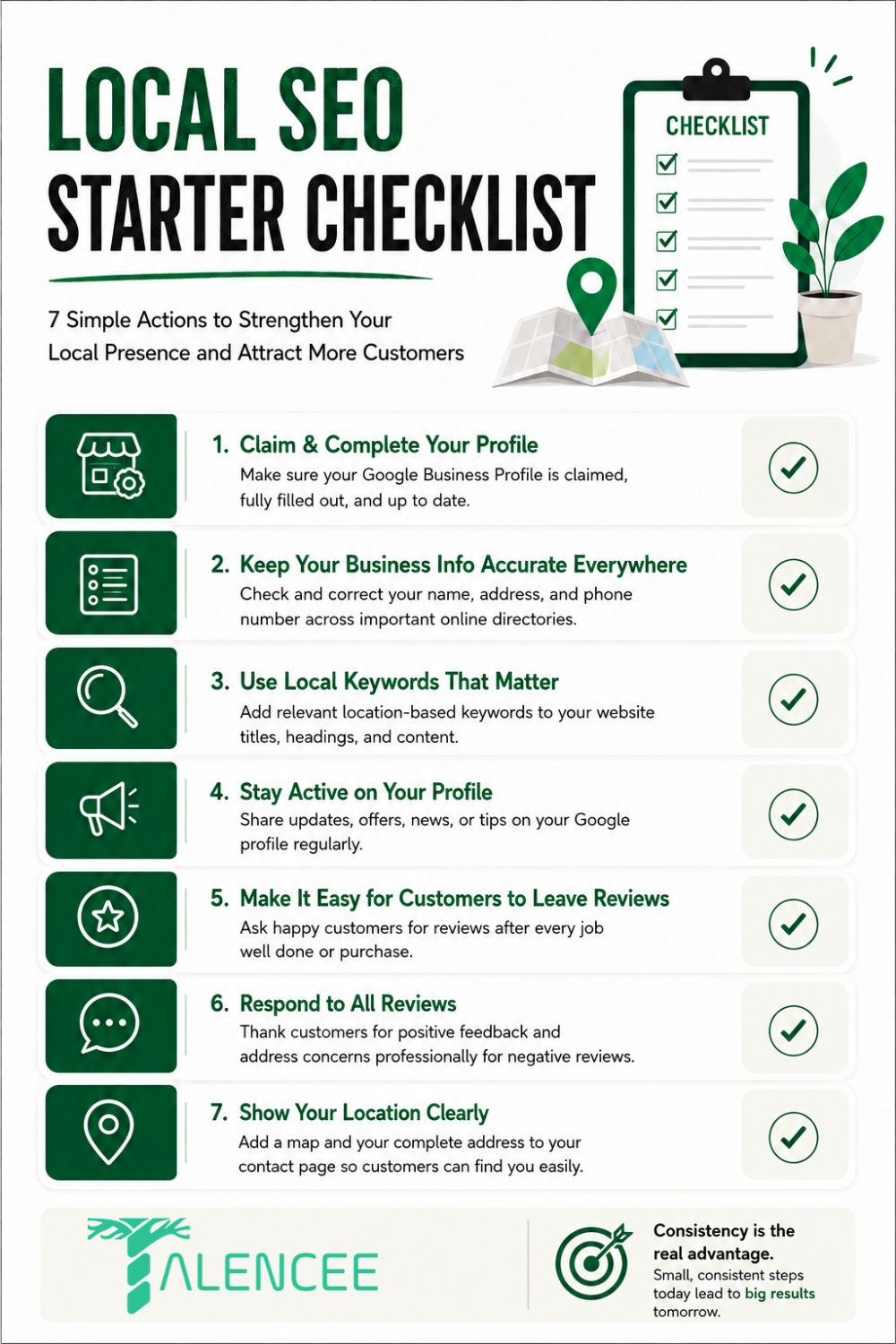
A Simple Local SEO Starter Checklist
☐ Claim and fully complete your Google Business Profile
☐ Audit your NAP consistency across at least 10 directories
☐ Add location-specific keywords to your homepage title tag and H1
☐ Post to your Google Business Profile at least once a week
☐ Set up a simple system to request reviews after every completed job or sale
☐ Respond to every review, positive or negative, within a few days
☐ Add a Google Map embed and your full address to your contact page
None of this requires a huge budget. It requires consistency, which is exactly where most small businesses fall behind.
FAQ
What is local SEO in simple terms?
Local SEO is optimizing your business so it appears when people nearby search for what you offer, most visibly in Google's map-based “local pack” results.
How is local SEO different from SEO?
Regular SEO competes for rankings globally based on content and backlinks. Local SEO competes within a geographic area and weighs proximity, Google Business Profile signals, and reviews much more heavily.
How long does local SEO take to show results?
Most small businesses see initial movement within 4 to 8 weeks after fixing Google Business Profile and citation issues, with more substantial ranking gains over 3 to 6 months of consistent work.
Do I need a website for local SEO?
It helps significantly, but Google Business Profile alone can generate visibility even before a website is fully optimized. A website becomes essential for converting that visibility into trust and bookings.
Is local SEO worth it for a single-location business?
Yes, arguably more so than for multi-location businesses, since all your local SEO effort concentrates on ranking for one area instead of being spread thin.
Do I need to post on Google Business Profile every day?
No. Once a week is enough to maintain active signals for most small businesses. Two to three posts a week suits more competitive categories, but daily posting isn't necessary and rarely adds proportional benefit.
What's the fastest way to improve my Google Business Profile ranking?
Correct category selection has the single largest individual impact within your profile, followed by overall completeness (photos, description, hours) and steady, genuine review growth over time.
Conclusion: Local SEO Is a System, Not a Setup
Local SEO isn't something you set up once and walk away from. It's five moving pieces, your Google Business Profile, NAP consistency, reviews, localized content, and local backlinks, and all five need to stay active at the same time. The good news is you don't need a big budget to compete. A fully filled-out profile, consistent business details across the web, and a habit of posting weekly will outperform a bigger competitor's half-finished listing more often than you'd expect.
Start with the checklist above and knock out the highest-impact items first: profile completeness and NAP consistency. Then treat reviews and posts as an ongoing habit, not a box you tick once. The businesses winning local search in 2026 aren't doing anything exotic. They're just doing the fundamentals consistently, while 58% of their competitors still aren't bothering.
Getting the fundamentals right on your own listing and citations is a solid start. Consistently posting, monitoring rankings, and managing reviews is where most small businesses run out of time. If you'd rather have this handled for you, here's what our local SEO services actually include.
Sources
• BrightLocal, Local Search Ranking Factors and Google Business Profile Statistics, 2026
• Google Business Profile Statistics, 2026, cited via Searchlab
• BizIQ, GBP Optimization Statistics 2026
• Local Falcon, GBP Posting Frequency Impact Study, 2025
• Digital Applied, Local SEO Statistics 2026
• Google / Think with Google, near-me search growth data