SEO Roadmap for Small Business: 8 Steps in the Right Order
By Harsh Rai
A simple SEO roadmap for small business: eight steps in order, from keyword research to monthly tracking, with what done looks like at each step.
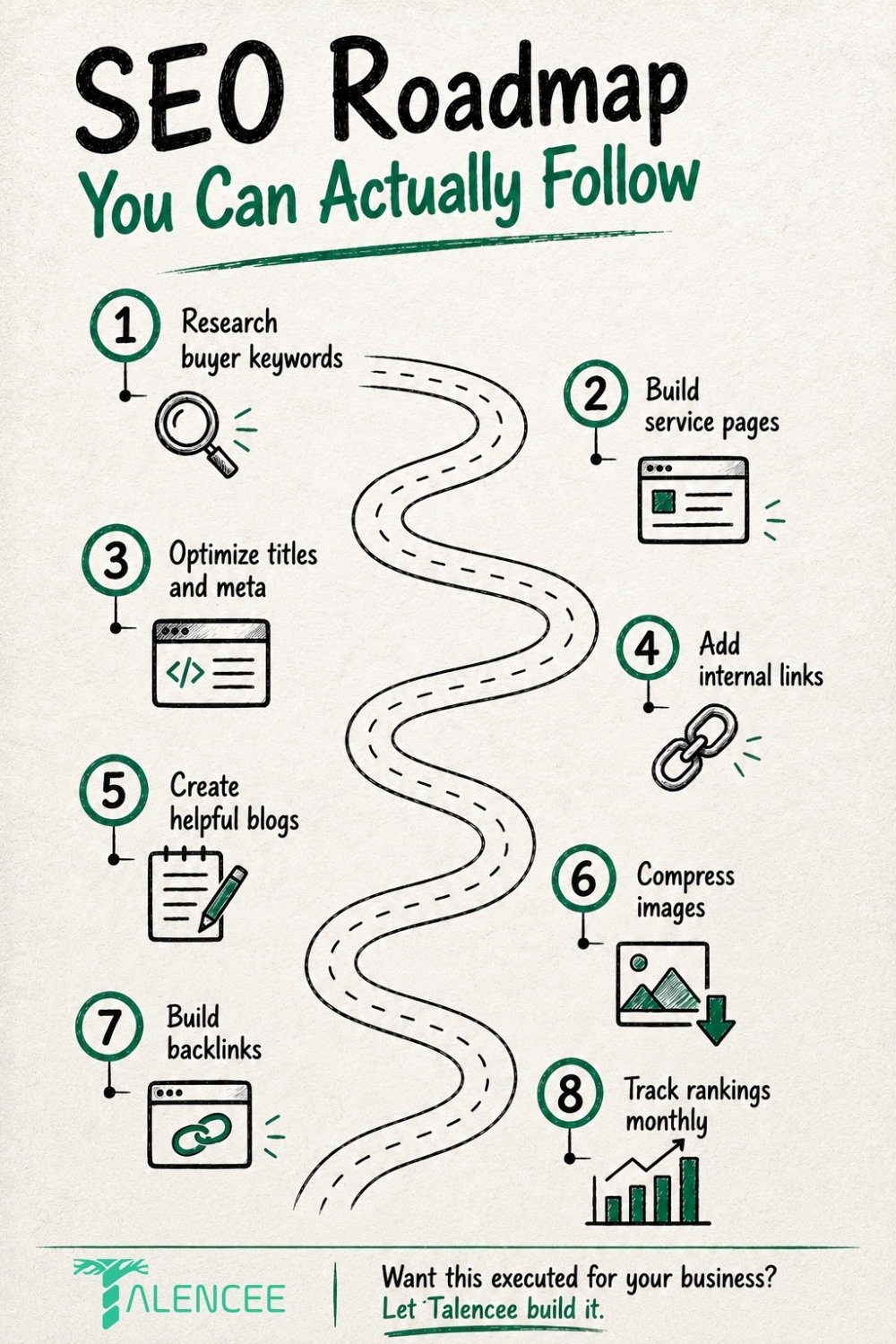
A working SEO roadmap for small business comes down to eight steps, done roughly in this order. First, research buyer-intent keywords. Second, build one dedicated service page for each keyword group. Third, optimize titles and meta descriptions. Fourth, add internal links that connect related pages. Fifth, create blog content that supports those pages instead of competing with them. Sixth, fix basic technical health, such as image size and site speed. Seventh, build relevant backlinks. Eighth, track rankings and traffic every month to catch problems early.
The order matters. Writing blog posts before your service pages exist, for example, is one of the most common reasons SEO effort never turns into leads. None of these steps is complicated on its own. What trips most service businesses up is doing them out of sequence, or jumping to the exciting steps, like blogging and backlinks, while the foundations never get proper attention. This guide explains each stage of the SEO roadmap for small business, what "done" looks like, and the mistake to avoid at every step.
Quick note: We are Talencee, and we offer SEO, so we have a stake in this topic. This SEO roadmap for small business works whether you do it yourself or hire help. Google itself says that a small local business can probably do much of the work on its own.
Before You Start: Set a Goal and a Baseline
Every SEO roadmap for small business works better with five minutes of preparation. Do these first:
• Pick one business goal. For example, "20 enquiry form submissions a month from search." A goal turns SEO from a vague activity into something you can measure.
• Set up Google Search Console. It is free and shows which searches already bring people to your site. Google's Search Console guide explains the setup.
• Set up analytics and track enquiries. You need to know which visits lead to calls, forms and messages, not just visits.
• List your services. Write down every service you sell, with the town or city you serve. This list drives Steps 1 and 2.
• Note where you stand today. Record your monthly clicks, impressions and enquiries. You will compare against these numbers later.
Step 1: Research Buyer-Intent Keywords
Research is the first stage of the SEO roadmap for small business, and the one everything else depends on. Start with Google Search Console if your site already gets some traffic, or a free keyword tool if you are starting fresh. The goal is not to find the highest-volume keywords. It is to find the searches people make right before they are ready to hire someone like you.
A search for "what is local SEO" is someone learning. A search for "local SEO services near me" is someone ready to pay. Both matter, but they belong on different types of pages. Learning searches suit blog posts. Ready-to-buy searches suit service pages.
For example, a home renovation contractor might find that "kitchen renovation cost estimate" gets more searches than "kitchen renovation company". That finding changes what the service page, and the blog content around it, should be built on.
How to do it:
1. Write a list of your services and the problems customers describe.
2. Search Google for each one and note the phrases that appear in suggestions and "People also ask".
3. In Search Console, open the Performance report and look at the queries you already show up for.
4. Mark each phrase as "learning" or "ready to buy".
5. If you serve a local market, add your city or area, and read our guide to local business SEO.
Done when: you have a short list of ready-to-buy keywords for each service, grouped by meaning.
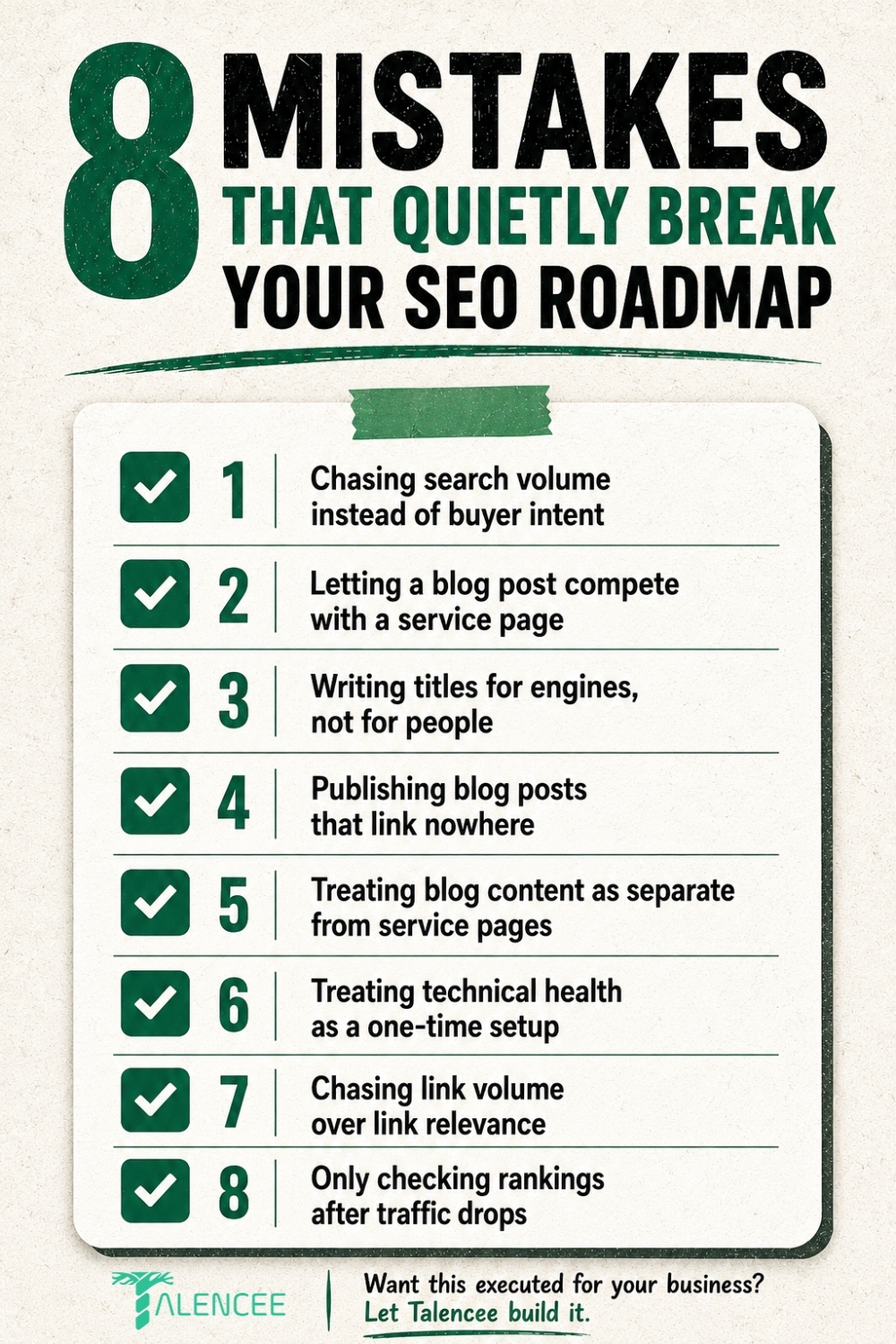
Common mistake: chasing high search volume instead of buyer intent, and ending up with traffic that never converts.
Step 2: Build a Dedicated Service Page for Each Keyword Group
Structure is the second stage of the SEO roadmap for small business. Group similar buyer-intent keywords together, then build one clear page per group. Do not try to rank one page for everything, and do not build five thin pages that split the same intent.
If two of your pages compete for the same search, Google will usually choose one to show, and the other adds little. This quiet problem, often called keyword cannibalization, wastes the effort you put into both pages. It is common and fixable.
A strong service page usually includes:
• A clear headline that says what you do and where
• A short summary of who the service is for
• What is included, and how the process works
• Proof, such as reviews, project photos or short case studies
• Prices or price guidance, if you can share them
• Common questions and honest answers
• One clear way to get in touch
Google's guidance on creating helpful, people-first content is a good test. Ask whether the page truly answers what a ready-to-buy visitor needs.
Done when: every service you want leads for has exactly one page, and no two pages target the same search.
Common mistake: letting an old blog post and a real service page compete for the same keyword, which usually ends with the weaker page winning by default.
Step 3: Optimize Titles and Meta Descriptions
Ranking well does not guarantee clicks. Your title and description are your advert in the results. A vague or generic title can cost you visits even when your ranking position does not change.
Published studies disagree about the average click-through rate for the top result. Figures range from under 10% to nearly 40%, depending on the method, the device, whether searches include a brand name and whether an AI answer appears. You can see the spread in this 2026 CTR report and in this CTR guide. Two things are consistent: higher positions earn far more clicks, and AI answers can reduce clicks. So do not trust any single benchmark. Use your own Search Console data.
A simple method:
1. In Search Console, find pages with many impressions but a low click-through rate.
2. Rewrite the title so it names the service, the place and one reason to choose you.
3. Rewrite the meta description as a short promise with a reason to click.
4. Wait a few weeks, then compare the click-through rate.
Google explains how it creates title links and snippets. It may rewrite them, but clear, accurate ones are still your best chance.
This step overlaps with broader on-page work. Headings, page structure and internal links all live here too, and it is worth treating as its own focused pass instead of an afterthought once a page is published. If you want expert help, see our on-page SEO work.
Done when: each key page has a unique, accurate title and description written for the person deciding whether to click.
Common mistake: writing a title for search engines instead of for the person deciding whether to click.
Step 4: Add Internal Links That Actually Make Sense
Internal links tie your SEO roadmap for small business together. Think of your site as a wheel. The homepage is the hub, service pages are the spokes, and blog posts feed visitors into those spokes.
Every blog post should link naturally into the service page it supports. Every service page should link sideways to two or three related pages, using real sentences instead of a generic "related pages" list at the bottom. Google recommends that links be crawlable, which means using normal links with clear anchor text.
Tips:
• Use descriptive anchor text, such as "kitchen renovation process", not "click here".
• Link from your strongest pages to the pages you most want to rank.
• Link only when it helps the reader take the next step.
• Check for important pages that no other page links to.
Done when: every service page has links in from relevant blog posts and links out to related services.
Common mistake: publishing blog content that never links anywhere, leaving readers with nowhere to go next.
Step 5: Create Helpful Blog Content, Without Competing With Your Own Pages
Content is where an SEO roadmap for small business most often goes wrong. Blog posts should target informational searches, not the same commercial keywords your service pages already aim for.
Writing a blog post and a service page for the exact same search is how businesses accidentally compete against themselves. One clearly informational post that guides readers to the right service page does more for growth than five posts fighting over the same commercial keyword.
Good blog topics for a service business:
• Cost and pricing explainers. "How much does a kitchen renovation cost?"
• How-to guides. "How to prepare your home for a renovation."
• Comparisons. "Renovate or move? How to decide."
• Checklists and mistakes. "Seven things to ask before hiring a contractor."
• Local guides. Advice that is specific to your area.
For each post, ask one question: which service page does this support? Then link to it clearly, near the top and at the end.
Structure posts so that readers and AI tools can find answers quickly. Put a direct answer first, use clear headings and add an honest FAQ. Google's guide to optimizing for generative AI is worth reading.
Done when: every blog post has one informational target, one service page it supports and a clear link to it.
Common mistake: treating blog content as a separate project from the service pages instead of building it to support them.
Step 6: Fix Basic Technical Health
Technical health is the quiet foundation of any SEO roadmap for small business. Compress images, check your Core Web Vitals scores and make sure nothing blocks search engines from crawling your pages.
None of this is visible to a typical visitor, which is exactly why it gets neglected, until a slow page quietly limits how well everything else performs. No amount of great content fixes a page that takes eight seconds to load.
A basic technical checklist:
• Compress images and use modern formats such as WebP. See Google's image guidance.
• Check Core Web Vitals in Search Console or PageSpeed Insights. Google explains them in its Core Web Vitals documentation.
• Make sure important pages can be indexed. Check that nothing is accidentally blocked or marked noindex.
• Fix broken links and errors. Use Search Console to find pages with errors.
• Check mobile layout. Most visitors will use a phone.
• Use one version of each URL. Redirect duplicates to the main page.
• Submit an XML sitemap. It helps Google find your pages.
If you want a specialist to run a deeper check, see our technical SEO fixes.
Done when: your key pages load quickly on a phone, are indexed and have no major errors.
Common mistake: assuming technical health is a one-time setup instead of something that needs occasional rechecking as a site grows.

Step 7: Build Relevant Backlinks
Links are the last major piece of the SEO roadmap for small business. Once your pages are solid, backlinks compound their effect. A single relevant, trustworthy link tends to do more for a fast, well-structured page than a dozen unrelated links do for a slow, thin one.
Quality and relevance matter more than volume. A mention from a genuinely relevant local publication or industry site usually outperforms a pile of generic directory links.
Safe ways to earn links:
• Local organisations and associations you already belong to
• Suppliers, partners and clients who can mention your work
• Local news and community sites when you have a real story to share
• Useful resources that others want to cite, such as a clear cost guide or checklist
• Guest articles on relevant industry sites
Avoid buying links or joining link exchange schemes. Google's spam policies warn that such practices can hurt your visibility.
Done when: you are earning a steady trickle of relevant links from real sites that your customers might also read.
Common mistake: chasing link volume from low-quality sources instead of a smaller number of genuinely relevant ones.
Step 8: Track Rankings and Traffic Monthly
Tracking keeps your SEO roadmap for small business honest. Monthly is a sensible default for most small business SEO programmes. Rankings and Core Web Vitals deserve a quick weekly glance for your most competitive keywords. Daily checking usually creates noise instead of insight, because normal ranking movement gets mistaken for a real problem.
Track these numbers:
• Clicks, impressions and click-through rate in Search Console
• Average position for your priority keywords
• Organic enquiries, meaning calls, forms and messages from search
• Pages that gained or lost traffic
• Technical issues, such as new errors or slow pages
Google's guide on using Search Console and Google Analytics data shows how to combine them.
It is also worth watching AI visibility. Search results increasingly include AI answers, and regular rank tracking will not show them. Once a month, ask your top buyer questions in Google and in a few AI tools, and note whether your business is mentioned or cited. If traffic drops suddenly, Google's guide to debugging traffic drops is a good place to start.
Done when: you have a one-page monthly report that shows traffic, rankings and enquiries, and you review it on a fixed date.
Common mistake: only checking rankings when traffic drops, instead of on a regular schedule that catches problems early.
Quick Recap
Here is the whole SEO roadmap for small business on one page.
Step | Main focus | If you skip this |
1. Keyword research | Find buyer-intent searches | Pages built around the wrong searches |
2. Service pages | One page per intent group | Pages competing against each other |
3. Titles and meta | Earn clicks after ranking | Rankings that do not convert to visits |
4. Internal links | Guide visitors to service pages | Readers with nowhere to go next |
5. Blog content | Support pages, do not compete | Blog posts stealing rankings from service pages |
6. Technical health | Keep pages fast and crawlable | Content that never gets properly indexed |
7. Backlinks | Build authority and trust | Slower rankings even with good content |
8. Monthly tracking | Catch problems early | Issues that go unnoticed for months |
How Long Does the SEO Roadmap for Small Business Take?
Exact timelines depend on your competition, your site and how much work you complete, and Google does not give a fixed schedule. As a common industry estimate, many service businesses see early movement, such as indexing, impressions and first traffic, within three to four months. More substantial and stable ranking gains often take six to twelve months. Ahrefs research has found that pages in the top ten are typically more than two years old, which shows how authority builds over time instead of appearing overnight.
You do not need to finish all eight steps before you see results. Fixing a poor title or a slow page can show effects within weeks. The full roadmap compounds over months.
A Simple Monthly SEO Routine
Once the foundations are in place, a light routine keeps your SEO roadmap for small business moving.
When | What to do |
Weekly (10 minutes) | Glance at Search Console for new errors and sudden drops |
Monthly (1 to 2 hours) | Review clicks, rankings and enquiries; update one or two titles; publish or refresh one blog post; add internal links to it |
Every quarter | Repeat keyword research and a page audit; fix cannibalization; review technical health and backlinks |
Twice a year | Check your service pages against your real services, prices and proof |
Revisit the keyword research and page audit steps roughly every 60 to 90 days. Search behaviour and your own rankings shift over time, so a roadmap that runs once and is never repeated slowly goes stale.
What to Do Yourself and What to Hand Off
You can complete much of this SEO roadmap for small business yourself, especially Steps 1 to 4 and the monthly check in Step 8. Google's own guidance says that a small local business can probably do much of the work, and it recommends starting with the SEO Starter Guide.
Help becomes useful when:
• You do not have the time to run every step each month.
• Technical problems need a developer or specialist.
• Content and link building need steady, skilled effort.
• You want a second opinion on strategy.
If you decide to hire help, read Google's tips on whether you need an SEO. It warns that no one can guarantee a number one ranking, and that you remain responsible for what any company you hire does on your site. For a cost comparison of hiring in-house versus using an outside team, see our guide to in-house vs outsourced SEO.
Frequently Asked Questions
Which step should I do first if I can only do one right now?
Keyword research, since every other step depends on knowing which searches are worth targeting. Building pages or writing blog content before this step usually means redoing the work later.
Can I skip building service pages and just write blog posts?
Not if you want to rank for ready-to-buy searches. Blog posts rank well for informational intent, but searches like "hire a plumber in Gurgaon" convert best on a dedicated service page built for that intent.
How many keywords should one service page target?
One core keyword plus several close variations that mean the same thing to a searcher. If two keyword groups have genuinely different intent, they need separate pages instead of one page stretched to cover both.
Do I need to finish all 8 steps before seeing any results?
No. Early technical fixes and title improvements can show impact within weeks. The full roadmap compounds over months, but you can see movement before you finish every step.
How often should I repeat this SEO roadmap for small business?
Revisit the keyword research and page audit steps roughly every 60 to 90 days. Run the monthly tracking routine continuously.
Do I need a blog for a service business?
Not at the start. Build your service pages first. Add a blog when you are ready to answer customer questions in depth and link those answers to your service pages.
What tools do I need to follow this SEO roadmap for small business?
At a minimum, Google Search Console, an analytics tool and PageSpeed Insights, all free. A paid keyword and tracking tool helps later, but it is not required to begin.
How much does SEO cost for a small business?
It depends on whether you do the work yourself or hire help. Doing it yourself costs mainly time. Hiring help adds a monthly fee. Get written quotes and compare what each includes.
Conclusion
The best SEO roadmap for small business is a simple one you can actually follow: find buyer-intent keywords, build one clear page for each, make the titles worth clicking, link your pages together, add helpful blog content that supports them, keep the site fast and crawlable, earn relevant links and track results every month. Do the steps in order, repeat them every quarter, and let the results compound.
Running all eight steps well, every month, is where most small businesses run out of time, not knowledge. If you would rather have this entire roadmap managed for you, see how our outsourced SEO team works, or contact us to talk through your goals.
Sources and Further Reading
• Google Search Central, SEO Starter Guide. The official beginner's guide to SEO.
• Google Search Central, Do you need an SEO?. Advice on doing SEO yourself or hiring help.
• Google Search Central, Creating helpful, reliable, people-first content.
• Google Search Central, Title links and Snippets.
• Google Search Central, Crawlable links, Core Web Vitals and Images.
• Google Search Central, Spam policies and Optimizing for generative AI.
• Google Search Central, Search Console getting started and Debugging traffic drops.
• Visionary Marketing, Google CTR by position, 2026. One of several studies of click-through rates.
• SEOcrawl, Click-through rate guide. Another study, which reports far lower figures.