Product Listing Optimization Checklist: 8 Checks Before Upload
By Harsh Rai
A product listing optimization checklist for sellers: eight checks before you upload, marketplace rules, India requirements and the order to fix them.
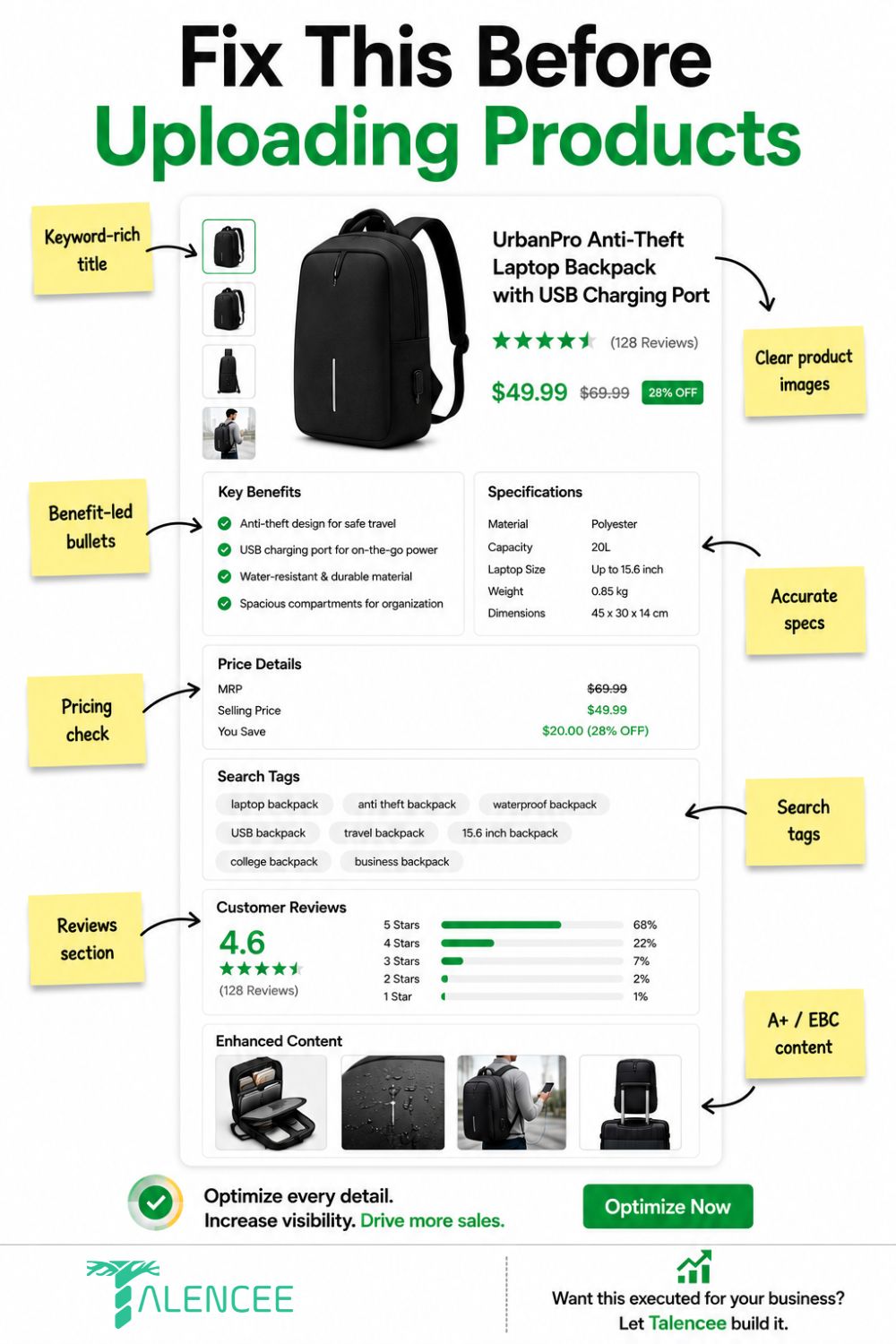
Product listing optimization is the work of making a product page easy to find, easy to trust and easy to buy from. A listing that converts needs eight things checked before it goes live: a keyword-rich title, clear product images, benefit-led bullet points, accurate specs, a competitive price check, the right search tags, a strong reviews section, and enhanced brand content such as A+ Content where the platform supports it. Skipping any one of these does not just lower conversion on that listing. It can also reduce how often the listing is shown at all, because marketplaces weigh relevance and conversion heavily when they rank products.
The stakes are high. In 2026 benchmark data from SellerSprite, typical Amazon sellers in the US convert between about 3% and 10% of visits, and top listings reach 10% to 15% or more, while general e-commerce sites mostly sit between 1% and 3%. Other sources quote higher averages for Amazon, so treat all of these as rough guides. The point is the gap: shoppers on a marketplace arrive ready to buy, and they compare your listing with several others in seconds. This product listing optimization checklist is built to survive that comparison.
Quick note: We are Talencee, and we offer product upload and e-commerce services, so we have a stake in this topic. The checklist works whether you do it yourself or hire help. Platform rules change often, and the legal section is general information, not legal advice.
What Is Product Listing Optimization?
Product listing optimization means improving every part of a product page so that shoppers find it in search and then choose to buy. On a marketplace, the main parts are the title, images, bullet points, description, backend search terms, enhanced content, reviews and price. On your own online store, the same ideas apply, with the addition of normal website SEO.
A marketplace ranks listings using two broad ideas. The first is relevance: does the listing match what the shopper searched for? The second is performance: do shoppers click it, buy it, keep it and rate it well? Nobody outside the platform knows the exact formula, and it changes. But relevance and conversion are consistent themes, and both are things you can improve.
Good product listing optimization does three jobs at once:
• Gets found. The right words in the right places, so the listing appears for the right searches.
• Earns the click. A clear main image, a readable title, a fair price and a good rating.
• Wins the sale. Benefits, proof, accurate details and answers to the questions buyers have.
The Product Listing Optimization Benchmarks to Know
Conversion rates differ by platform, category, price and fulfilment method, so use these figures as rough guides, not targets.
Listing type | Typical conversion rate |
General e-commerce website | About 1% to 3% |
Typical Amazon listing (US sellers, 2026) | About 3% to 10% |
Strong Amazon listing | About 10% to 15% or higher |
These numbers come from SellerSprite's 2026 benchmark guide, and they relate to US sellers. SellerSprite also reports that listings fulfilled by Amazon convert roughly 20% to 35% better than seller-fulfilled ones, which shows that delivery promise matters as much as copy. Other published guides quote higher averages for Amazon, because definitions and data sources differ. For an Indian marketplace, the right benchmark is your own history. Record your current conversion rate for each product, then try to beat it.
The 8 Things to Check Before Any Listing Goes Live
Run these eight checks on every product as part of your regular product listing optimization routine.
1. Keyword-Rich Title
Your title does two jobs. It determines whether the listing shows up in search, and it is the first thing a shopper reads before deciding to click.
How to write it:
1. Front-load the main keyword. Put the product type early, such as "Stainless Steel Water Bottle".
2. Add the details that differ. Brand, size, material, colour, quantity or key feature.
3. Respect the character limit. Since January 2025, Amazon applies a 200-character limit to titles, including spaces, across its stores. Other marketplaces have their own limits, so check your seller portal.
4. Write for mobile. Only the first part of a long title shows on a phone, so the most important words should come first.
5. Avoid stuffing and claims. Do not repeat keywords or add promotional words such as "best" or "sale". They read as spam to shoppers and may break platform rules.
Example. Weak: "Water Bottle Steel Bottle Gym Bottle Best Bottle Sale". Better: "Brand Name Stainless Steel Water Bottle, 1 Litre, Leakproof, Insulated, Pack of 1".
2. Clear Product Images
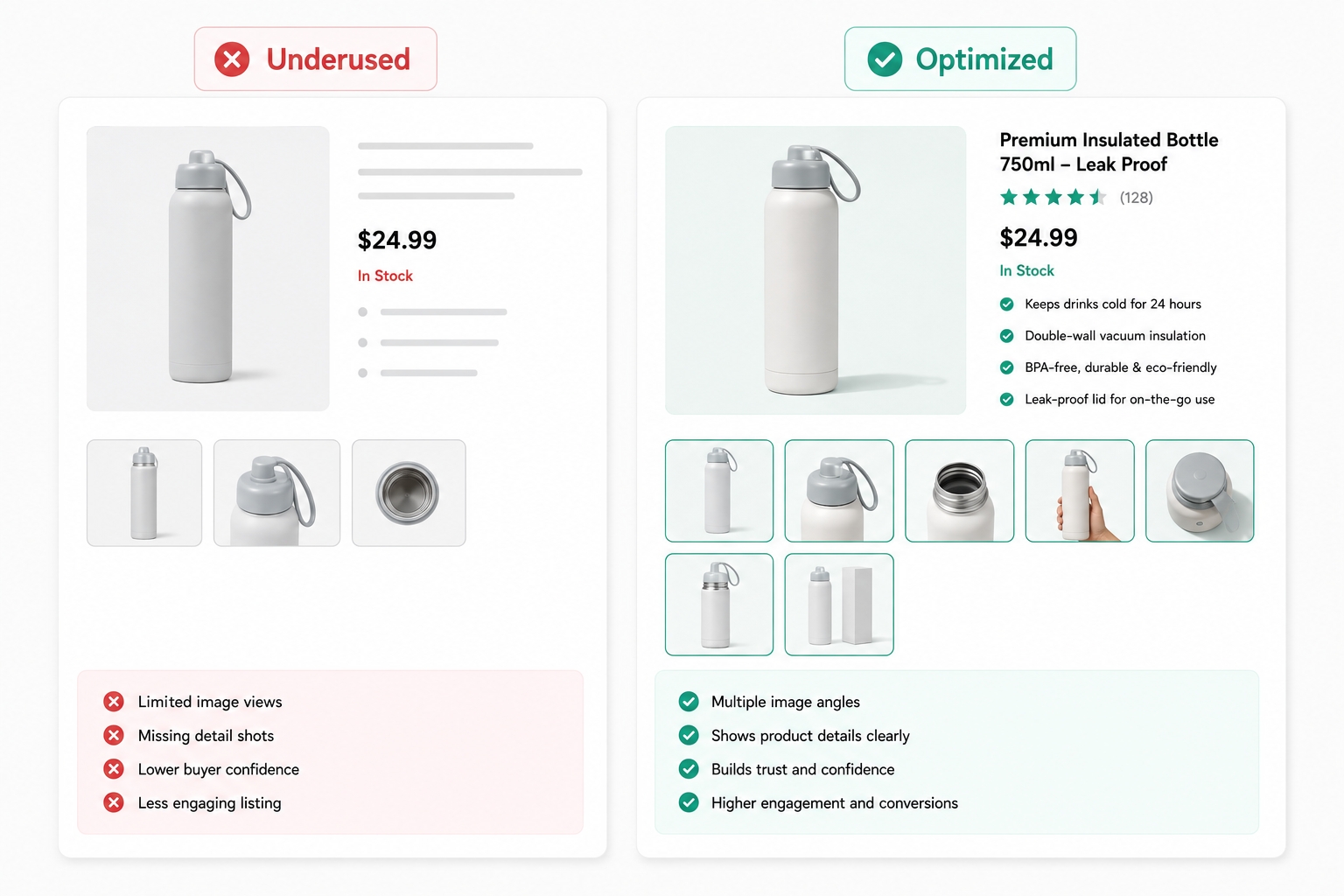
Images are usually the first thing a shopper looks at, and the main image decides whether they click. Most sellers underuse the image slots a platform gives them.
Amazon's published image rules, which many other marketplaces mirror, give a useful baseline:
• The main image should show the product alone on a pure white background (RGB 255, 255, 255).
• The product should fill about 85% of the frame.
• Images should be at least 1,000 pixels on the longest side so that zoom works, and larger images are better.
• You can usually upload several images, up to nine on Amazon, so use them all.
You can read these rules summarised in this content guide for Amazon, and Amazon's own seller forum repeats them. Check the current requirements for your category in Seller Central, because categories differ.
A strong image set usually includes:
1. A clean main image
2. Several angles
3. A size or scale reference, such as the product next to a hand
4. A lifestyle image showing the product in use
5. An infographic image listing key features
6. A "what is in the box" image
7. A size or compatibility chart, where relevant
Design for mobile first. Most shoppers will see your images on a small screen, so text on images must be large and simple.
3. Benefit-Led Bullets
Specs tell a shopper what a product is. Bullets must tell them what it does for them. "18/8 stainless steel" is a spec. "Will not rust or stain after years of daily use" is a benefit built on that spec. The best listings lead with the benefit and use the spec to prove it.
How to write product bullet points:
1. Use all five bullets where the category allows them.
2. Start each bullet with a short benefit phrase, then back it up with the detail.
3. Cover one idea per bullet, such as durability, ease of use, size, care and what is included.
4. Keep them scannable. A common guide is about 50 to 250 characters per bullet, though limits vary by category.
5. Follow platform rules. Amazon, for example, does not allow price, shipping or company details in bullets.
6. Answer real questions. Use customer questions and reviews to find what shoppers worry about.
Example. Spec-led: "Double-wall vacuum insulation, 304 steel." Benefit-led: "KEEPS DRINKS COLD OR HOT ALL DAY: Double-wall vacuum insulation holds temperature for hours, so your tea or water stays the way you poured it."
Avoid claims you cannot prove. If a bullet says "keeps cold for 24 hours", make sure that testing supports it.
4. Accurate Specs
Wrong or missing specs lead to returns and negative reviews, even when the product is fine. Over time, return rates and review sentiment can hurt a listing far more than a weak title.
Check each of these against the real product, not an old catalogue:
• Dimensions and weight, in clear units
• Material and finish
• Compatibility, such as models, sizes or voltage
• Quantity and pack contents
• Care instructions and warranty terms
• Certifications, where the category needs them
In India, several details are also legally required on listings. See the section on mandatory listing details below.
5. Pricing Check
Marketplaces and shoppers compare your price with similar listings. You do not need to be the cheapest, but you do need to be understandable. A higher price needs a clear reason in the images and copy, such as better material, a longer warranty or a larger pack.
Checks to run:
1. Compare with five to ten close competitors for the same product type and quality.
2. Compare the total cost, including delivery charges and any extras.
3. Make the offer clear. Show the MRP, the selling price and any real discount honestly.
4. Review after changes. If you change price, watch conversion for a few weeks before changing again.
5. Avoid price wars on products where your margin is thin. Competing on clarity and trust is often safer.
6. Search Tags
Backend search terms and tags do not appear on the listing, but they help determine which searches the listing can be found for. Use them for synonyms, alternate spellings and related terms that do not fit naturally in the title or bullets.
Tips:
• Respect the limits. On Amazon, the backend search terms field has a limit of 250 bytes. If you go over, Amazon may ignore all of the terms, so keep within it.
• Do not repeat words already in the title, brand or bullets.
• Skip punctuation and filler words, because they waste space.
• Use terms shoppers actually type. In India, that may include alternate names, spelling variants and local terms for the same product.
• Never add competitor brand names or irrelevant terms. This can get a listing suppressed.
7. Reviews Section
Reviews act as both a trust signal and a ranking signal on most marketplaces. A listing with strong, recent reviews converts better than an identical listing with few or old ones.
What to do:
1. Ask real customers for honest reviews using the platform's own tools and policies.
2. Never buy, fake or incentivise reviews. This breaks platform rules, and India's review standard, IS 19000:2022, is aimed at exactly this problem. You can read about the government's push to make it mandatory, and the position may have changed since.
3. Read negative reviews as research. They show which specs, images or bullets need fixing.
4. Answer customer questions quickly and clearly.
5. Fix the cause. If many reviews mention the same problem, improve the product or the listing.
If a listing is new and has no reviews yet, everything else on this checklist matters even more, because there is no review trust to lean on while it builds.
8. A+ or Enhanced Brand Content
For brand-registered sellers, enhanced content modules, such as comparison charts, lifestyle imagery and expanded storytelling below the standard bullets, can add real conversion lift. On Amazon, A+ Content generally requires Brand Registry. Other marketplaces have their own equivalents.
Good enhanced content:
• Compares your product with your other products in a simple chart
• Shows the product in use
• Answers common questions with images
• Tells the brand story briefly
• Uses large, readable text on mobile
Platforms report lifts from enhanced content, but figures vary by category and listing, so test it and measure it on your own products. It is usually the last thing sellers add, and often the thing that deserves attention once the other seven basics are solid.
Mandatory Listing Details for Sellers in India
Product listing optimization in India has a legal layer that many guides skip. If you sell in India, several product details are not optional. This section is general information, not legal advice. Please check current rules for your category.
• Consumer Protection (E-Commerce) Rules, 2020. These require sellers on marketplaces to give the relevant details about goods, including country of origin, so that buyers can decide before they buy. In 2021, the Central Consumer Protection Authority issued more than 200 notices over missing or false country of origin declarations.
• Legal Metrology (Packaged Commodities) Rules, 2011. These require e-commerce listings to show details such as the manufacturer's or packer's name and address, country of origin, the product's common name, net quantity, the maximum retail price and, where relevant, dimensions and best-before dates.
• Platform checks. Marketplaces now build these into their forms. Flipkart's compliance page for sellers, for example, lists the need to show net quantity, MRP inclusive of all taxes, seller details and country of origin.
Wrong or missing declarations can lead to listings being blocked, penalties or buyer complaints. Check each product against your platform's checklist before you upload.
Product Listing Optimization Checklist at a Glance
Check | What good looks like | Quick test |
Title | Main keyword first, key details, within the limit | Read it aloud. Does it still make sense on a phone? |
Images | Clean main image, several angles, lifestyle, infographic | Zoom in on a phone. Is it sharp and easy to read? |
Bullets | Benefit first, then spec, one idea each | Can a shopper learn why to buy in ten seconds? |
Specs | Complete, accurate and legally compliant | Check every number against the real product |
Price | Fair against close competitors, clear offer | Would you pay it after comparing three listings? |
Search tags | Synonyms and variants, no repeats, under the limit | Are the terms new, or already in the title? |
Reviews | Honest, recent, answered | Are there recurring complaints to fix? |
Enhanced content | Comparison, lifestyle and story, readable on mobile | Does it add answers the bullets do not? |
How Fast Does Product Listing Optimization Work?
Unlike SEO on a website, marketplace changes can show effects quickly, because the platform responds to real shopper behaviour. Many sellers see movement within a few weeks. But results vary by category, traffic and competition, and no honest provider can promise a fixed percentage lift.
To read results fairly:
1. Change one major element at a time, such as the main image or the title, so you know what caused the result.
2. Wait for enough traffic. A listing with a handful of visits a day needs more time to show a real pattern.
3. Track weekly, not daily. Daily numbers are noisy.
4. Compare like with like. Festival seasons, promotions and stock-outs change conversion for reasons unrelated to your edits.
5. Record what you changed and when. A simple log makes patterns easy to spot.
The Order to Fix These In If You Are Starting From Scratch
With a whole catalogue to optimise and limited time, the order of your product listing optimization matters more than perfecting one listing before moving to the next.
• Start with images and the title. These two drive the most clicks, so they pay off fastest across every listing.
• Move to bullets and specs next. Once a listing is getting clicks, this is what turns clicks into add-to-cart decisions.
• Handle pricing and search tags after that. These matter, but they refine a listing that already has strong fundamentals.
• Add reviews strategy and enhanced content last, once the basics are proven to convert. There is little point polishing enhanced content on a listing whose core images and copy are not yet working.
• Prioritise by sales. Start with your best sellers and the products with the most traffic and potential.
Marketplace Conversion Rate Optimization: How to Measure and Test
Marketplace conversion rate optimization is the testing side of product listing optimization: the habit of trying changes and measuring the result. Track these numbers for each product:
• Impressions and click-through rate, which show whether the title, main image and price earn the click
• Sessions and unit session percentage, which show how many visits turn into orders
• Returns and return reasons, which show where specs and images set the wrong expectation
• Rating and review themes, which show what customers like and dislike
• Sales rank or sales trend, as a rough indicator of progress
If you are brand registered, your platform may offer built-in testing tools for titles, images and enhanced content. Where it does not, test by changing one element and comparing equal periods.
Common Mistakes That Undo Good Product Listing Optimization
• Testing many things at once. Title, images and price together make it impossible to learn which change worked.
• Treating optimization as a one-time job. Competitors update their listings and category standards shift.
• Copying a template from another category. Shoppers in each category care about different details.
• Ignoring mobile. Most marketplace traffic is mobile, and a listing that reads well on desktop can lose key information on a small screen.
• Keyword stuffing. It hurts readability and can break platform rules.
• Promising what the product cannot do. This drives returns and bad reviews.
• Skipping legal declarations. Missing details can get a listing blocked.
• Neglecting stock and delivery. A great listing cannot fix frequent stock-outs.
DIY or Get Help With Product Listing Optimization?
Task | Safe to do yourself? | When to get help |
Writing titles and bullets | Yes, with the checklist above | For a large catalogue or many categories |
Product photography | Yes, with a simple setup | For hero images on top sellers |
Specs and compliance | Yes, with careful checking | For regulated categories |
Bulk uploads and catalogue clean-up | For small catalogues | For hundreds of products or several marketplaces |
Enhanced content design | With templates | When brand look and consistency matter |
Testing and reporting | Basic tracking | For regular analysis across many products |
If you have a large catalogue and want it uploaded and optimised consistently, see our e-commerce product upload service. If you are building or rebuilding your own online shop, our e-commerce development service covers the platform itself.
Frequently Asked Questions
What is product listing optimization?
Product listing optimization is the process of improving a product page, including its title, images, bullets, specs, search terms, reviews and enhanced content, so that it ranks in marketplace search and converts more visitors into buyers.
How long does it take to see results from product listing optimization?
Often within a few weeks. Marketplace algorithms respond to real shopper behaviour quickly, so changes tend to show measurable impact faster than typical website SEO, where results usually take months. The amount of improvement varies, so measure your own listings.
Do I need professional photography, or can I do it myself?
Professional photography often pays for itself, given how much images drive clicks and conversion. But a well-lit, clean DIY setup with a plain background can work as a starting point. What matters most is having enough images covering angles, scale and use cases, and meeting the platform's rules for the main image.

What matters most if I can only fix one thing right now?
Images first, then bullets. The hero image wins or loses the click, and the bullets decide whether the product matches what the shopper needs. After that, check specs and price.
How do I write product bullet points that convert?
Start each bullet with a short benefit, then back it up with the specification. Cover one idea per bullet, keep them easy to scan, answer real customer questions and follow your platform's rules on length and content.
Does product listing optimization work the same way on every marketplace?
The principles carry over: clear images, benefit-led copy, accurate specs. The specifics differ. Amazon, Flipkart and other marketplaces have different field limits, image rules and ranking signals, so a listing built for one usually needs adapting when you expand to another.
How often should I revisit an already-optimised listing?
Every few months at minimum, and sooner if a competitor visibly updates theirs or your conversion rate starts to drift down. Category standards and shopper expectations change over time.
Should every product in a catalogue get the same level of optimization effort?
No. Prioritise by sales volume or growth potential first. A handful of high-traffic listings fully optimised will move overall revenue more than spreading the same effort thinly across the whole catalogue.
What is a good conversion rate for a marketplace listing?
It depends on the platform, category, price and fulfilment method. US benchmark data puts typical Amazon listings between about 3% and 10%, with strong ones above that. Compare your own listings with your past results and close competitors, not with one number.
Conclusion
Product listing optimization is a set of small, checkable decisions: a clear title, strong images, benefit-led bullets, accurate specs, a fair price, smart search tags, honest reviews and, where available, enhanced content. Each one is simple. Together they decide whether a shopper clicks, trusts and buys.
Run through all eight checks before you upload, fix things in the right order and measure the results. Good product listing optimization is never really finished, because competitors and shoppers keep changing. Running these checks on every listing takes real time, especially across a full catalogue. If you would rather have it handled for you, see our e-commerce product upload service, explore our e-commerce development work, or contact us to talk through your catalogue.
Sources and Further Reading
• SellerSprite, Amazon conversion rate benchmarks by category, 2026. Conversion ranges, and the effect of fulfilment method.
• E-tailize, Content rules for Amazon. Title limit and main image rules since January 2025.
• Amazon Seller Central, seller forum guidance on titles, bullets, images and search terms. Bullet count, image requirements and the 250-byte search term limit.
• Moneylife, CCPA notices to e-commerce sellers. Country of origin requirements under the Consumer Protection (E-Commerce) Rules, 2020.
• Flipkart, seller compliance requirements. Legal Metrology and consumer rules for listings.
• India Retailing, Anti-fake-review rules proposal. IS 19000:2022 and the push to make it mandatory.