On-Page vs Technical vs Off-Page SEO Explained (2026)
By Harsh Rai
Understand the three pillars of SEO—on-page, technical, and off-page—and learn how to prioritize them to improve rankings, visibility, authority, and long-term search performance.
On-page vs technical vs off-page SEO is a question many site owners ask. Here is the short answer.
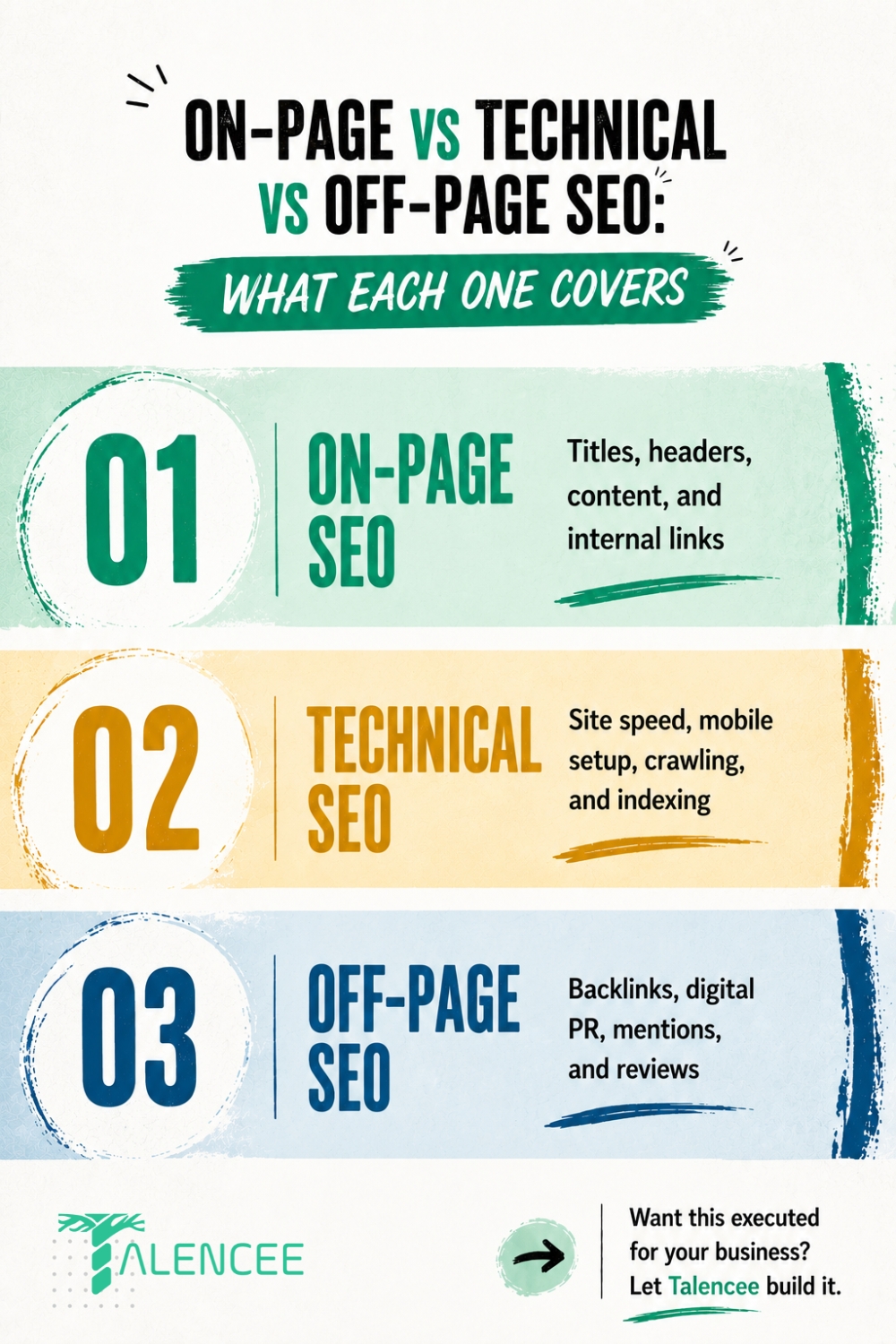
On-page SEO covers what's written and structured on a single page: titles, headers, content, and internal links. Technical SEO covers how well search engines can crawl, index, and load your site: things like speed, mobile-friendliness, and clean code. Off-page SEO covers signals from outside your website that build trust and authority: backlinks, brand mentions, and reviews. All three work together, but they solve different problems, and neglecting one usually caps how much the other two can achieve.
Most SEO confusion comes down to mixing these three up, or assuming one alone is enough. A business owner might spend months writing blog posts while the site quietly blocks Google from crawling half of them. Another might pay for backlinks pointing at pages that are thin, slow, and hard to read. In both cases the effort is real, but it is aimed at the wrong layer of the problem. Here's what each category actually covers, how they connect, and how to decide where to focus first.
Why the Three Pillars of SEO Matter
Think of SEO as a building. Technical SEO is the foundation and structure, on-page SEO is the interior that visitors actually walk through, and off-page SEO is the reputation that makes people want to visit in the first place. A beautiful interior is useless if the doors are locked, and a strong reputation won't help if the rooms are empty or confusing.
Search engines evaluate all three layers when deciding which pages deserve to rank. They need to access your content (technical), understand and value it (on-page), and trust it enough to recommend it over alternatives (off-page). A weakness in any one of these can hold the others back, which is why a balanced view matters more than any single tactic.
How the Three Layers Interact
The layers are not isolated. A fast, well-structured page makes every backlink more valuable. Clear on-page content gives search engines something worth crawling. Strong technical health means that when a respected site links to you, the page they point to loads quickly and works on a phone. When you improve one layer, you often raise the ceiling for the other two.
On-Page SEO: What's Actually On the Page
On-page SEO includes title tags, meta descriptions, headers, content quality and structure, internal links, image alt text, and schema markup. It's the layer most directly under your control, since none of it depends on other websites or your hosting setup.
It matters even after you already rank. The average click-through rate for the top Google result is around 39.8%, dropping to about 18.7% for the second position, according to 2026 CTR data. A poorly written title or meta description can quietly cost you most of that gap even when your ranking position doesn't change at all.
Title Tags and Meta Descriptions
Your title tag is often the first thing a searcher reads, and it tells search engines what the page is about. A strong title is specific, includes the main topic naturally, and promises something the page actually delivers. The meta description doesn't directly decide rankings, but it works like a small advertisement beneath the title. A clear, benefit-focused description gives people a reason to click your result instead of the one above or below it.
Common mistakes include duplicate titles across many pages, titles that are cut off because they are too long, and descriptions that are left blank so the search engine pulls random text from the page instead.
Headers and Content Structure
Headers (H1, H2, H3) do two jobs. They help readers scan a page, and they help search engines understand how ideas on the page relate to each other. A page should have one clear H1 that states the main topic, with H2s for major sections and H3s for supporting points beneath them. Skipping levels or using headers purely for styling makes a page harder to interpret.
Content quality is the heart of on-page work. The key question is whether the page answers the searcher's query clearly and completely. That usually means leading with the direct answer, then adding depth, examples, and context for readers who want more. Pages that ramble, repeat themselves, or bury the answer tend to lose out to pages that respect the reader's time.
Internal Linking
Internal links connect your pages to each other, helping visitors move through your site and helping search engines discover content and understand which pages matter most. Descriptive anchor text, such as a phrase that tells the reader what they will find, works better than vague text like "click here." A good habit is to link from older, established pages to newer ones that deserve visibility.
Image Alt Text and Schema Markup
Alt text describes an image for people using screen readers and gives search engines context about what the image shows. Write it for humans first: short, accurate, and descriptive. Schema markup is a layer of structured code that labels your content, such as marking up an FAQ, a product, or an article, so search engines can interpret it more precisely and sometimes display richer results. Schema is where on-page work often overlaps with technical work, and it may need light developer help.
Avoiding Keyword Cannibalization
One of the quieter on-page problems is covering the same topic across several weak pages. When multiple pages compete for the same query, none of them builds enough strength to rank well. Consolidating overlapping content into one strong, comprehensive page usually performs better than spreading effort thin.
Technical SEO: The Foundation Nobody Notices Until It Breaks
Technical SEO covers crawlability, indexing, site speed, mobile responsiveness, Core Web Vitals, structured data, HTTPS, clean URL structure, and XML sitemaps. None of it is visible to a typical reader, which is exactly why it gets neglected.
It's invisible when it's working and costly when it's not. A single crawl-blocking error, a broken redirect, or a slow-loading page can quietly undo months of content work, since none of that content gets properly indexed or ranked if Google can't access it cleanly.
Crawlability and Indexing
Before a page can rank, search engines must be able to find it (crawling) and store it in their database (indexing). Problems here are among the most damaging because they remove pages from the game entirely. Typical culprits include a robots.txt file that accidentally blocks important sections, stray "noindex" tags left over from a development stage, orphan pages with no links pointing to them, and long redirect chains that waste crawl effort.
An XML sitemap helps by giving search engines a clean list of the pages you want them to find. It is not a guarantee of indexing, but it makes discovery easier, especially on larger sites or new ones with few external links.
Site Speed and Core Web Vitals
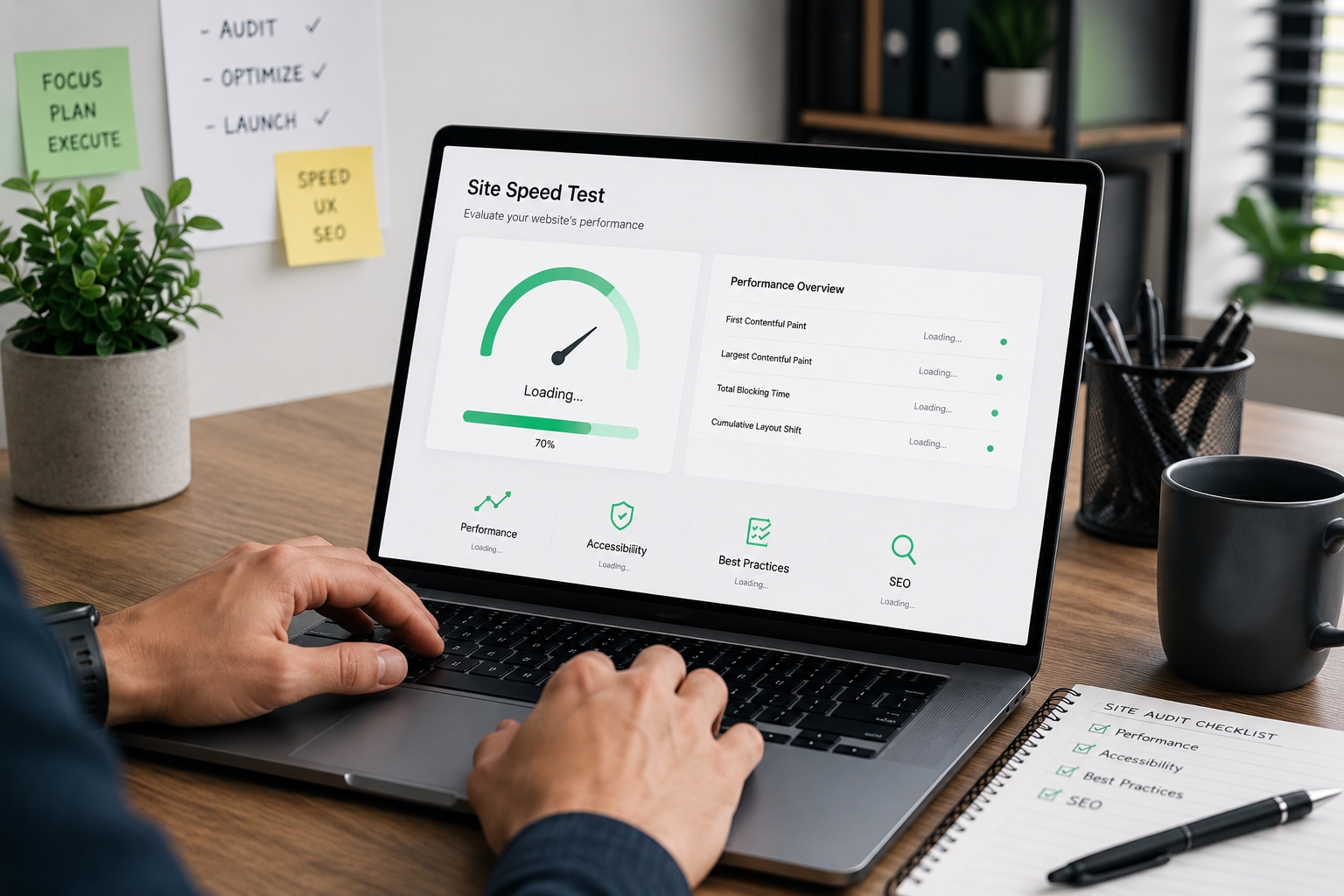
People abandon slow pages, and search engines take that behavior seriously. Core Web Vitals are Google's way of measuring real user experience, looking at how quickly the main content loads, how soon the page responds to interaction, and whether the layout jumps around while loading. Common fixes include compressing images, reducing heavy scripts, using caching, choosing reliable hosting, and avoiding bloated themes or plugins.
Mobile Responsiveness
Most searches now happen on phones, and search engines evaluate the mobile version of your site. A page that works well on desktop but has tiny text, overlapping buttons, or content that doesn't fit the screen creates a poor experience. Responsive design, readable font sizes, and tap-friendly navigation are baseline requirements rather than extras.
HTTPS, URLs, and Clean Code
HTTPS protects visitors' data and signals that your site is trustworthy. Clean, readable URLs that reflect the page topic help both users and search engines, while messy parameter-heavy URLs can create duplicate content problems. Canonical tags tell search engines which version of a page is the main one when similar versions exist. Clean, lightweight code keeps pages fast and easier to crawl.
Why Technical Problems Hide for So Long
Because technical issues are invisible to casual visitors, they often go unnoticed until traffic drops. A site migration, a theme update, or a plugin change can introduce errors without any visible sign. Regular checks using tools such as Google Search Console, plus periodic crawls of your site, catch these problems before they quietly erode your results.
Off-Page SEO: What Happens Outside Your Website
Off-page SEO covers backlinks, brand mentions, reviews, social signals, and digital PR, essentially anything that builds trust and authority from outside your own site.
Ahrefs data shows that top-ranking pages tend to gain roughly 5 to 14% more referring domains each month than lower-ranked competitors, reflecting a strong correlation between authority and rankings, though correlation isn't the same as pure cause and effect. What's changed in 2026 is that quality and relevance now outweigh raw link volume; a handful of contextually relevant, trustworthy links tends to outperform a large pile of unrelated ones.
Backlinks: Quality Over Quantity
A backlink is a vote of confidence from one site to another, but not all votes carry equal weight. A link from a respected, relevant publication in your industry says far more than dozens of links from unrelated or low-quality sites. Chasing volume through shortcuts, such as bought links or link exchanges, carries risk and rarely delivers lasting value. Earning links through useful content, original insights, and genuine relationships is slower but far more durable.
Brand Mentions and Reviews
Even when a mention doesn't include a link, it can contribute to how recognizable and credible your brand appears. Reviews on trusted platforms influence both search visibility, especially for local businesses, and the decision of a potential customer who is comparing options. Responding professionally to reviews, positive or negative, shows that real people stand behind the business.
Digital PR and Social Signals
Digital PR means creating something newsworthy, such as original research, a helpful tool, or an expert opinion, and getting it in front of journalists, bloggers, and industry publications. Social media may not directly move rankings, but it spreads content to people who might link to it, share it, or mention your brand. Think of social activity as a way to create the conditions where links and mentions can happen.
Which One Should You Prioritize First?
If your site has crawl or indexing errors, or is painfully slow, technical SEO comes first. Nothing else matters if Google can't properly access your pages in the first place.
If technical health is already solid but your content isn't ranking or converting, on-page usually comes next. Are you actually answering the query clearly, structured well, and covered once on a strong page rather than spread thin across several weak ones?
Off-page investment, like backlinks and digital PR, tends to pay off best once on-page and technical are already solid. A single strong, fast, well-structured page earns more from each new backlink than a page that's slow or thin. It's not unusual to see a page with a comparatively modest backlink profile outrank a bigger competitor simply because its on-page structure and content depth are clearly stronger, especially for less competitive, specific queries.
A Simple Order of Operations
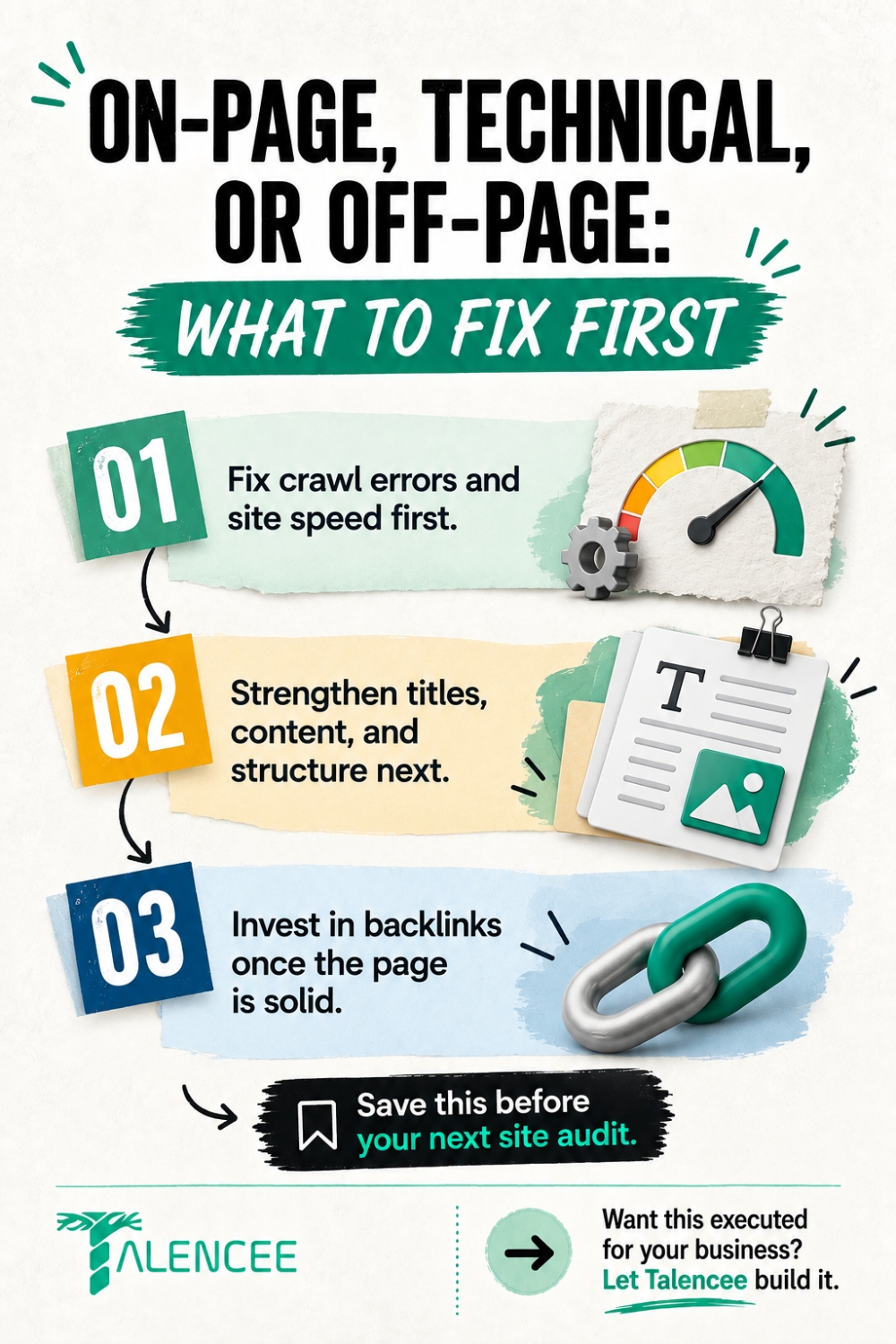
If you are unsure where to begin, this sequence works for most sites:
1. Check technical health. Confirm your important pages are crawlable, indexed, fast, and mobile-friendly.
2. Fix and strengthen on-page elements. Improve titles, descriptions, headers, content depth, and internal links on the pages that matter most to your business.
3. Build off-page authority. Once your pages are worth linking to, invest in outreach, digital PR, and reputation building.
4. Review and repeat. SEO is ongoing, so revisit all three layers regularly as your site and your competitors change.
Common Mistakes to Avoid
• Publishing lots of content on a site with unresolved crawl or speed problems.
• Buying links to pages that haven't been improved.
• Treating SEO as a one-time project instead of continuous maintenance.
• Optimizing for search engines at the expense of readability.
• Ignoring the click-through side of the equation, such as weak titles and descriptions.
Quick Comparison
Category | Covers | Examples | Typically owned by |
On-Page | What's written and structured on the page | Titles, headers, content, internal links, schema | Content or marketing team |
Technical | How well the site is built and crawled | Site speed, mobile setup, indexing, Core Web Vitals | Developer or technical SEO specialist |
Off-Page | What builds trust from outside the site | Backlinks, digital PR, reviews, brand mentions | Outreach or PR team |
FAQ
What's more important, on-page or off-page SEO?
Neither works well without the other, but on-page is usually the better starting point since it's fully within your control and doesn't depend on outreach or other websites linking to you.
Can I do on-page SEO myself without technical knowledge?
Yes, largely. Writing clear titles, structuring content with proper headers, and adding internal links doesn't require developer skills. Schema markup and some structural changes may need light technical help.
How long does technical SEO take to fix?
Simple fixes, like broken redirects or missing meta tags, can be resolved within days. Larger technical overhauls, like migrating to a faster hosting setup or restructuring a large site, can take several weeks.
Do I need all three, or can I focus on just one?
You need baseline technical health regardless, since it affects whether Google can access your site at all. Beyond that baseline, most small businesses get the best early return from on-page work before investing heavily in off-page.
What's the difference between technical SEO and on-page SEO exactly?
Technical SEO is about whether search engines can access and load your site properly. On-page SEO is about what your content actually says and how it's structured once a page is accessible. One is infrastructure, the other is content.
Conclusion: Building SEO That Actually Works
On-page, technical, and off-page SEO are three parts of one system. Technical SEO makes sure search engines can reach, load, and understand your site. On-page SEO makes sure each page answers the searcher's question clearly and earns the click. Off-page SEO builds the trust and authority that convinces search engines your content deserves to rank above the competition. Each solves a different problem, and each limits the results of the other two when it is ignored.
The practical takeaway is to work in the right order. Start by making sure your site is accessible, fast, and mobile-friendly. Then sharpen the content and structure of the pages that matter most. Once those foundations are solid, invest in backlinks, reviews, and digital PR, because every new link is worth more when it points to a strong page. Avoid the common trap of putting all your effort into a single layer, and treat SEO as ongoing maintenance rather than a one-off task.
Figuring out where your site currently stands across all three usually takes an outside look, not guesswork. If you'd like that audit done for you, here's what our on-page SEO services actually cover.
Sources
• Wellows / FirstPage, click-through rate by SERP position data, 2026
• Ahrefs referring-domains growth data, cited via Search Engine Land, 2026
• ClickRank, Google SEO Ranking Factors 2026 guide
• Backlinko, Google Ranking Factors, 2026 update