LinkedIn Outreach Strategy: 7 Steps That Don't Feel Spammy
By Harsh Rai
A LinkedIn outreach strategy built on a 7-step sequence: example messages, safe limits, where the data disagrees and how to measure your own results.
A LinkedIn outreach strategy that works follows seven steps: view the prospect's profile first, send a personalised connection request, wait a day or two, share something genuinely useful, ask a soft, low-pressure question, offer a quick audit or a specific piece of value, then move the conversation to a call. The order matters as much as the content. Skipping straight to a pitch is exactly what makes outreach feel spammy in the first place.
The data behind LinkedIn outreach is more contested than most guides admit. Large 2026 datasets put connection acceptance somewhere between roughly 19% and 29%, depending on who ran the study. Some report that a personalised note barely changes whether people accept, while others report that it nearly doubles replies. This LinkedIn outreach strategy guide gives you the seven-step sequence, example messages, safe limits, the points where the research disagrees and how to measure your own results, because your own numbers matter more than any benchmark.
Quick note: We are Talencee, and we offer LinkedIn lead generation, so we have a stake in this topic. Most of the benchmark studies we cite come from outreach-tool vendors, who have an incentive to report flattering numbers, so we hedge them. LinkedIn also bans most third-party automation, which affects how you should run any sequence. The compliance section is general information, not legal advice.
What Is a LinkedIn Outreach Strategy?
A LinkedIn outreach strategy is a plan for starting conversations with the right people on LinkedIn, building enough trust to have a real discussion and turning some of those discussions into meetings. It has seven parts:
• A clear target. Who you want to reach, and why they should care.
• A credible profile. The page prospects see when they check you out.
• A warm-up. Showing up in their feed before you message them.
• A sequence. The order and timing of your messages.
• Useful content. What you share and what you ask.
• Follow-up rules. When to stop.
• Measurement. The numbers that tell you what works.
A sequence is only one part. Many outreach campaigns fail before the first message, because the list is wrong or the profile does not give a reason to reply.
Before You Send Anything: Profile, Targeting and Warm-Up
Every LinkedIn outreach strategy works better with preparation, so fix these first. They affect every step below.
Your profile
• A clear photo and a headline that says who you help and how, not just your job title
• An "About" section that explains the problem you solve, in plain words
• Recent activity, such as a post or comment, so the account looks alive
• Proof, such as a featured case study, a testimonial or a short guide
Your target list
• Define your ideal customer: industry, company size, role, location and the problem they have.
• Build a small, accurate list first. Twenty well-chosen people beat two hundred random ones.
• Check each person's role and company before adding them.
• Note one specific reason to contact each person.
A short warm-up
• Follow the prospect, and like or comment on one or two recent posts with something useful to say.
• Keep comments genuine. A thoughtful sentence is better than a generic "Great post!"
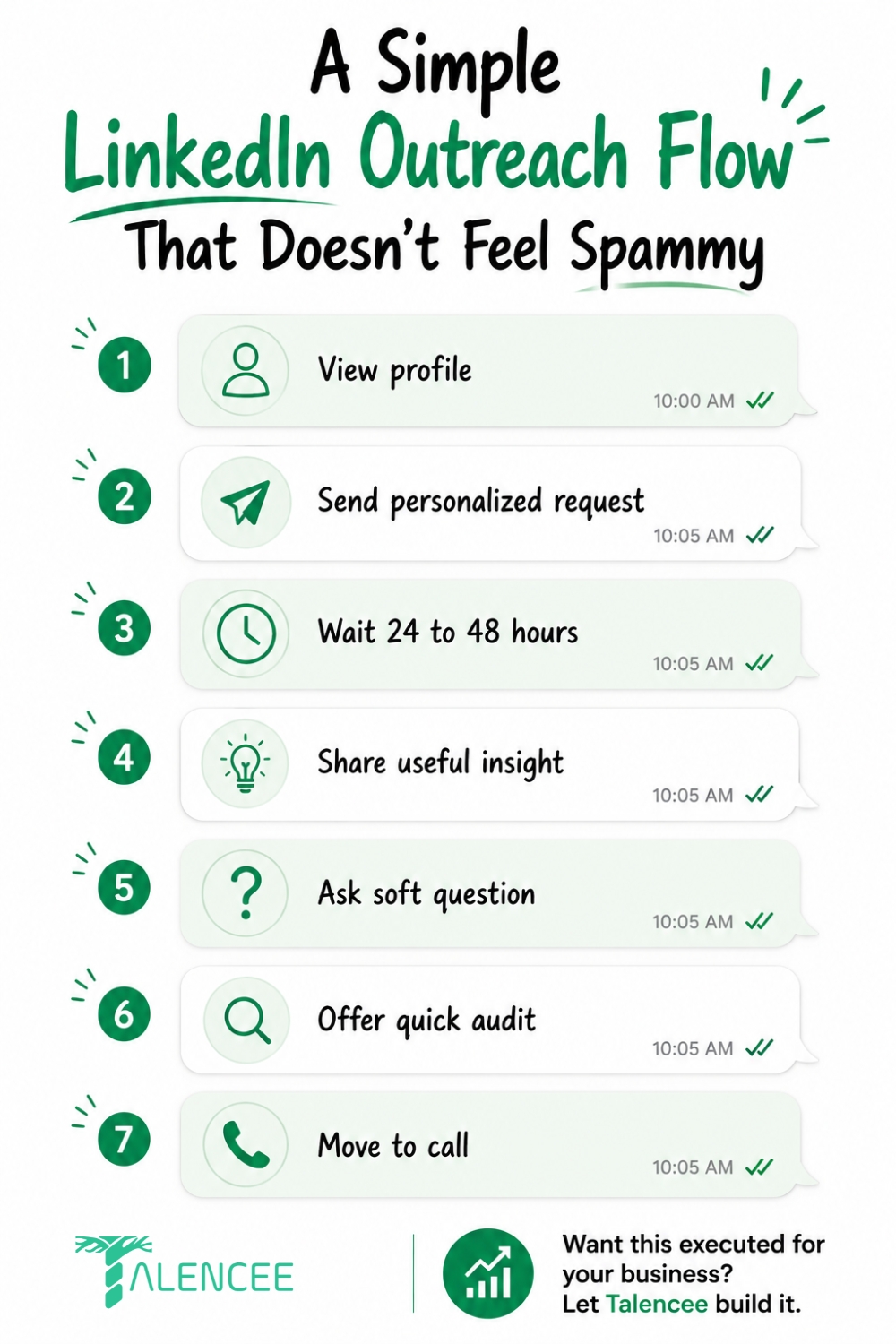
The 7-Step Sequence
Each step of this LinkedIn outreach strategy includes what to do, an example and the mistake to avoid. Examples are fictional. Write your own in your own voice.
1. View Profile
Before you send anything, read the prospect's profile: their role, their recent posts, any shared connections or groups, and anything that gives you a real reason to reach out. This step gets skipped constantly, and it shows in how generic the resulting message reads.
What to look for:
• A recent post or comment you can refer to
• A change in role, a new product or a company announcement
• A shared connection, group or event
• A problem their role usually faces
Common mistake: sending a request to someone whose profile you have not read.
2. Send a Personalized Request
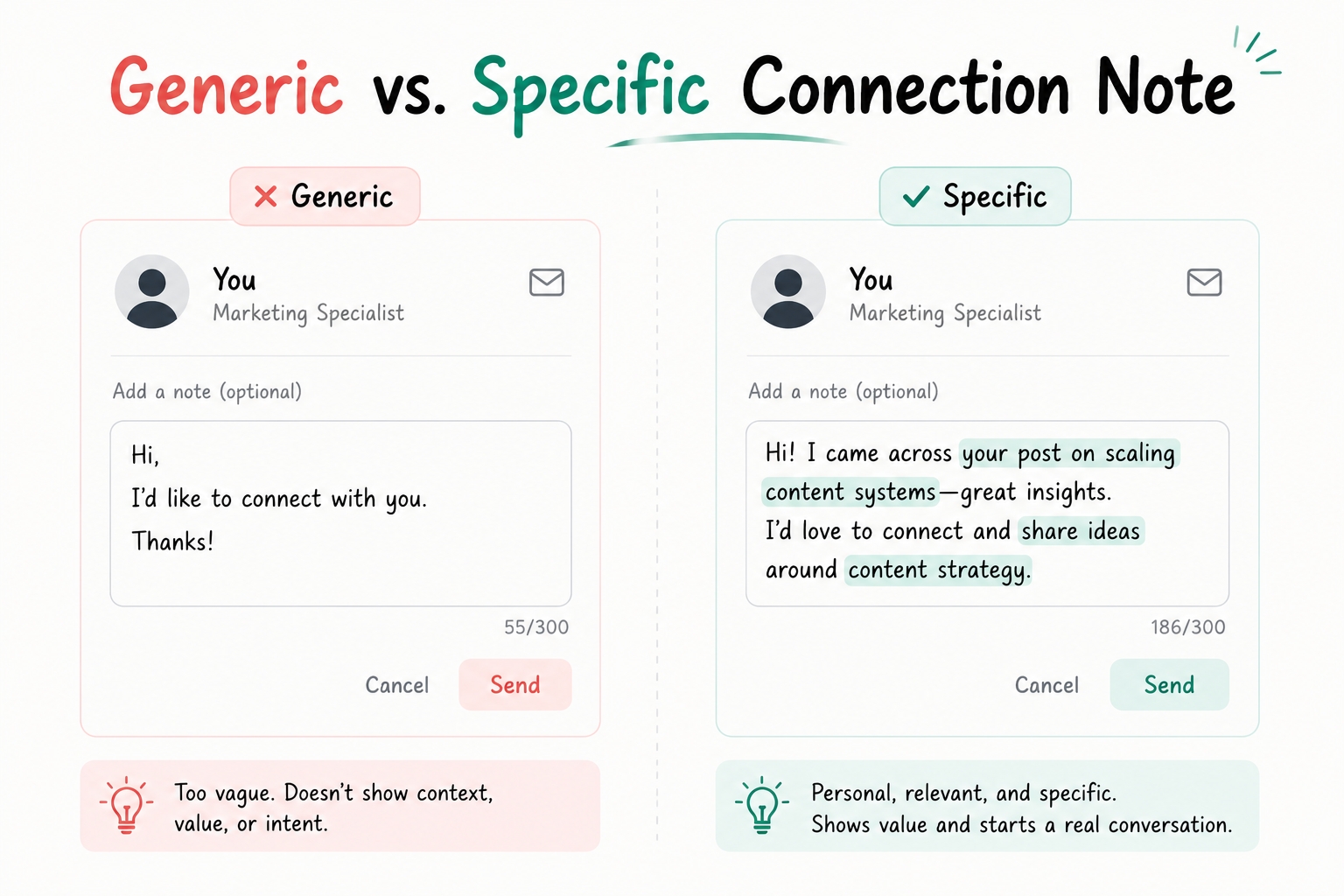
Refer to something specific from their profile or a shared connection, instead of the generic "I'd love to connect." A note should be short. LinkedIn limits the length of a connection note, and sources report limits of about 200 characters on free accounts and about 300 on paid ones, so check your own account.
Example note (under 200 characters): "Hi Priya, your post on slow lead response caught my eye. I work with service firms on exactly that problem. Would be glad to connect."
Why it works: it names something real, says why you are reaching out and asks for nothing.
A personalised note may or may not change whether someone accepts. We cover the disagreement in the data below. A note that is clearly written for that person, and not copy-pasted, makes a reply more likely once you are connected.
Common mistake: a pitch inside the connection note.
3. Wait 24 to 48 Hours
Messaging the moment a connection is accepted reads as automated, because it usually is. A short gap lets the interaction feel like two people who happened to connect, instead of a sequence running the second a connection lands.
Use the gap to do something useful: look at their recent posts again, or engage with one.
Common mistake: a "Thanks for connecting, here is my service menu" message within minutes.
4. Share Something Useful
Before you ask for anything, lead with value: a relevant article, a specific observation about their industry, or a genuine comment on something they posted.
Example message: "Thanks for connecting, Priya. I saw your post on lead response times. In our experience, firms that call new enquiries within the hour book far more meetings than those that wait until the next day. Here is a short checklist we use, in case it helps. No reply needed."
Why it works: it gives, it is short and it asks for nothing. Use only claims you can stand behind.
Common mistake: attaching a brochure or sales deck.
5. Ask a Soft Question
Instead of pitching, ask something low-pressure that invites a reply without asking for a commitment, such as how they are handling a specific challenge, what has changed on their team or whether a trend affects them.
Example message: "Curious, how does your team handle follow-up when enquiries come in after hours? Always interested in how different firms approach it."
A question is easier to answer than a pitch, and every reply keeps the conversation going a little longer.
Common mistake: asking a question that is really a pitch in disguise, such as "Would you like to improve your lead response by 40%?"
6. Offer a Quick Audit or Specific Value
Once there is real back-and-forth, offer something concrete and low-commitment: a quick audit, a short teardown or a specific insight tailored to what they have told you. This is the first moment it is appropriate to mention what you do, framed as a specific offer instead of a general pitch.
Example message: "Based on what you described, I could look at your enquiry-to-call process and send you three quick fixes. It takes me about 20 minutes. Would that be useful?"
Common mistake: offering a vague "free consultation" with no clear outcome.
7. Move to a Call
Only after a genuine exchange, suggest a short call, framed around what you have already discussed and not a generic "let's hop on a call to discuss synergies."
Example message: "Happy to walk you through what I found. Would 15 minutes on Thursday or Friday work? I will keep it to the three points we discussed."
A call request that refers to the actual conversation is far easier to say yes to than one that could have been sent to anyone.
Common mistake: pushing for a call before the other person has said anything.
Message Examples You Can Adapt
Step | Example opening | Why it works |
Connection note | "Hi [name], your post on [topic] caught my eye. I work on [specific problem]. Glad to connect." | Specific, short, no ask |
First message | "Thanks for connecting, [name]. Here is a short [resource] on [topic] that may help." | Gives value first |
Soft question | "Curious how your team handles [situation]?" | Easy to answer |
Offer | "I could look at [specific thing] and send three quick fixes. Useful?" | Concrete, low commitment |
Call request | "Happy to walk through what I found. Would 15 minutes on [day] work?" | Refers to the conversation |
Keep each message short, and read it aloud before you send it.
What the Data Actually Agrees On
Reported statistics for any LinkedIn outreach strategy vary widely by source, method and how each study defines a reply, so treat any single number cautiously. Remember also that most of these studies come from vendors that sell outreach tools.
Measure | What the studies report |
Connection acceptance, overall | About 28.5% across 13.2 million requests (Expandi); about 21% across 96,000 campaigns and 18.7% to 26% in other datasets (as compiled by SmartReach) |
Reply to a message after connecting | About 10.4% on average (Expandi) |
Reply to the connection note itself | Fell from about 3.5% to about 2.2% between May 2025 and April 2026 (Expandi) |
Best reply day | A small difference between weekdays, with Tuesday highest in one dataset (Belkins) |
You can read the sources in Overloop's benchmark roundup, Expandi's 2026 benchmarks and Belkins' study.
What holds up across most of them:
• Acceptance is not the funnel. A request that is accepted may never lead to a reply or a meeting. SmartReach notes that almost every published benchmark stops at acceptance or first reply.
• Targeting matters more than volume. SmartReach's report says that a low acceptance rate is a list problem to fix before adding more effort. Sending fewer, better-targeted requests tends to work better than sending as many as the platform allows.
• Connection-note replies are shrinking. Expandi's data shows replies to the note itself falling, possibly because so many senders use similar templates.
• Messages still get replies. The reply rate to post-connection messages stayed near 10% in the same data.
A Note on Personalization, Where Sources Disagree
Personalisation is the biggest open question in any LinkedIn outreach strategy, and not every study agrees on how much it matters.
Dataset | Acceptance with a note | Acceptance without a note | Replies with a note | Replies without a note |
Belkins, 20M+ attempts, as cited by Expandi and Overloop | 26.42% | 26.37% | 9.36% | 5.44% |
Belkins study page (15M+ touchpoints) | 25.3% | 27.6% | 8.2% | 5.3% |
Overloop also reports that another vendor's sample found blank requests had the higher acceptance rate. The honest takeaway is that a note is unlikely to change whether someone accepts, and may even lower acceptance slightly. Where personalisation shows up consistently is in what happens after connecting: a short, relevant note tends to produce more replies. A bad or salesy note can hurt, and a blank request from a credible profile can be a safe default at scale. Test both with your own audience.
Practical Limits and LinkedIn's Rules
Your LinkedIn outreach strategy has to respect both limits and rules. LinkedIn does not publish exact numbers, and they change. Third-party guides report the following, and none of it is official:
• Weekly invitations: about 100 for most accounts, with some reaching 150 to 200, and flagged accounts dropping far lower.
• Personalised notes on free accounts: a small monthly allowance, with sources reporting anywhere from 3 to 10 a month. Paid plans are reported to have no such cap.
• Note length: about 200 characters on free accounts and 300 on some paid accounts.
• InMail and open profiles: messages sent through InMail credits or to members with Open Profile do not count against the weekly invitation limit, according to the same sources.
Sending near the weekly cap does not mean sending at the cap is the strategy. Fewer, better-targeted requests tend to work better, and they are also safer for your account.
LinkedIn's rules matter more than any limit. LinkedIn's help page on prohibited software and extensions says that third-party software which scrapes or automates activity on the platform breaks its User Agreement, and that it can lead to restricted accounts. Many outreach tools market automation anyway, and several of the benchmark studies above come from those same vendors.
A safer way to run a sequence:
• Send requests and messages yourself, or with a trained team member.
• Use LinkedIn's own tools, such as saved searches and Sales Navigator, for finding people.
• Track people and replies in a CRM or spreadsheet, not in a bot.
• Avoid tools that log in as you, send messages automatically or scrape profiles.
• Never share your login with an outside tool or provider you do not trust.
What This Looks Like in Practice
Here is a fictional example of the LinkedIn outreach strategy in action. A prospect posts about struggling with slow lead response times. The outreach opens with a connection note that refers to that exact post, not a generic introduction. After the prospect accepts, two days pass before any message. The first message shares a short, genuinely relevant observation about response times, with no ask attached. A reply comes back. The next message asks a soft question about how they currently handle follow-up. Only after that exchange does a quick, specific audit offer come up, tailored to what they have already described. The call request, when it finally comes, refers to the actual conversation.
Every step in that example ties back to something the prospect actually said or posted. That specificity, more than any script or template, is what separates a sequence that feels like a real conversation from one that feels like software running on autopilot.
A Suggested Cadence
A LinkedIn outreach strategy needs a cadence. This timing is a starting point, not a researched rule. Adjust it to how the other person responds.
When | Action |
Day 0 | View the profile. Send the connection request. |
Day 2 to 3 after accepting | Send a useful message with no ask |
Day 6 to 8 | Ask a soft question, if there has been no reply |
Day 12 to 14 | Offer a specific audit or insight |
After a reply | Let the conversation set the pace. Suggest a call when it fits. |
After no replies | Send one polite last message, then stop |
Consent, Privacy and Opt-Outs
A responsible LinkedIn outreach strategy also protects prospects' data. Outreach involves personal data, so a few habits protect you and your prospects. This is general information, not legal advice.
• Respect a no. If someone declines or asks you to stop, stop and note it.
• Be honest about who you are and why you are writing.
• Use professional context only. Do not use scraped personal emails or phone numbers from unknown sources.
• Follow data protection rules. India's Digital Personal Data Protection Act, 2023 may apply to the personal data you collect and store. The government notified the DPDP Rules in November 2025, with a phased rollout, and you can read the official summary in this Press Information Bureau document. If you contact people in other regions, their local laws may apply too.
• Keep records of who you contacted, when and what they said.
For more on the legal side of B2B outreach, see our guide to B2B lead generation services in India.
How to Measure Your Own LinkedIn Outreach Strategy
Your own numbers are the best benchmark. Track this funnel for every batch of requests:
Stage | What to count |
Requests sent | The number of invitations |
Accepted | Share of requests accepted |
Replied | Share of accepted connections who replied |
Positive replies | Replies showing real interest |
Meetings booked | Calls scheduled |
Opportunities | Meetings that became real sales opportunities |
Good habits:
1. Record every batch with the date, the audience and the message used.
2. Change one thing at a time, such as the note or the first message.
3. Use enough volume. Tiny batches of 20 give noisy results, so compare several batches.
4. Judge by meetings and opportunities, not only acceptance.
5. Review weekly, and rewrite messages that get no replies.
6. Ask your sales team about lead quality.
Common Mistakes in a LinkedIn Outreach Strategy
• Pitching in the connection note. It reads as an advert.
• Skipping the profile check. Generic messages show immediately.
• Messaging straight after accepting. It signals automation.
• Sending too many requests to the wrong people. Fix the list first.
• Using automation tools that break LinkedIn's rules. Your account is at risk.
• Chasing people who have not replied. One polite follow-up is enough.
• Copying one template for everyone. Receivers spot it quickly.
• Measuring only acceptance. Replies and meetings tell you more.
• Neglecting your profile. Prospects look at it before they reply.
DIY or Get Help With Your LinkedIn Outreach Strategy?
You can run this LinkedIn outreach strategy yourself. Use the table to decide where help is useful.
Task | Safe to do yourself? | When to get help |
Profile and positioning | Yes | When your offer is unclear |
Building a target list | Yes, for small lists | For larger, regular list building |
Writing messages | Yes, with the examples above | When replies stay low |
Sending and follow-up | Yes, in small batches | When your team cannot keep up |
Tracking and reporting | Basic spreadsheet | For CRM setup and dashboards |
Strategy and testing | With patience | For regular, structured programmes |
If you would rather have a team handle the targeting, writing and tracking, see our LinkedIn lead generation and LinkedIn sales outreach services.
Frequently Asked Questions
What is a LinkedIn outreach strategy?
A LinkedIn outreach strategy is a plan for reaching the right people on LinkedIn, starting conversations that build trust and turning some of them into meetings. It covers your profile, target list, message sequence, follow-up rules and measurement.
How long should I wait between each step in the sequence?
Waiting 24 to 48 hours after a connection is accepted before the first message is a reasonable default. After that, let the conversation's own pace guide timing instead of following a rigid schedule.
Is it worth using automation tools for LinkedIn outreach?
Be careful. LinkedIn says that third-party software which scrapes or automates activity breaks its User Agreement and can lead to restricted accounts. For finding people and tracking replies, tools can help. For reading a profile and writing something specific to that person, no tool replaces you.
What is a realistic reply rate to expect?
Published figures vary widely by source and definition. One large vendor dataset reports about 10% on messages after connecting, while note replies are lower and falling. Track your own rate over time, and treat any outside number as a rough reference, not a target.
Should the first message ever include a pitch?
Generally no. The sequence works because it earns attention before asking for anything. A pitch in the first message after connecting is one of the most common reasons outreach gets ignored or reported.
What if someone does not reply after step 4 or 5?
One further soft follow-up after a reasonable gap is fine. Beyond that, move on. Repeated messages to someone who has not engaged do more harm than a missed conversation costs.
How many connection requests can I send a week?
LinkedIn does not publish a fixed number. Third-party guides report about 100 a week for most accounts, sometimes more, and lower for accounts that have been flagged. Fewer, well-targeted requests tend to work better than sending as many as possible.
Does this sequence work outside sales?
The core principle applies to any professional outreach: research first, lead with value and ask before you pitch. It suits recruiting, partnerships and networking. The steps around audits and calls are most relevant to sales and business development.
What should I write in a connection note?
Keep it short and specific. Refer to one real thing from their profile or a shared connection, say why you are reaching out and ask for nothing. Check the character limit on your account.
Conclusion
A good LinkedIn outreach strategy is a series of small, respectful steps. Read the profile. Send a specific request. Wait a little. Give something useful. Ask a simple question. Offer something concrete. Then suggest a call. Keep your volume modest, your list accurate and your account within LinkedIn's rules.
The data on what works is more contested than most guides admit, so measure your own results. Track acceptances, replies, meetings and opportunities, and change one thing at a time.
Running a LinkedIn outreach strategy consistently, across enough prospects to matter, is where most teams run out of time, not ideas. If you would rather have this built and managed for you, explore our LinkedIn lead generation and LinkedIn sales outreach services, or contact us to talk through your goals.
Sources and Further Reading
• Overloop, LinkedIn outreach benchmarks. A compilation of 2026 studies, including Belkins and Expandi data.
• Expandi, LinkedIn outreach benchmarks 2026. Acceptance, reply and note-reply figures from 13.2 million requests.
• Belkins, LinkedIn B2B outreach statistics. Note versus no-note comparison.
• SmartReach, The State of LinkedIn Outreach 2026. Comparison of acceptance rates across datasets.
• LinkedIn Help, Prohibited software and extensions.
• Press Information Bureau, DPDP Rules, 2025 summary.
• Note: Overloop, Expandi, Belkins and SmartReach sell or promote outreach tools or services, so treat their figures as indicative, and see the weekly limits in third-party guides as unofficial.