In-House SEO vs Outsourced SEO: Which Actually Costs Less?
By Harsh Rai
In-house SEO vs outsourced SEO: compare real salary, tool and hiring costs in India, see when each wins and use a simple scorecard to decide.
In-house SEO vs outsourced SEO is one of the first big decisions a growing business faces when it takes organic search seriously. For most small and mid-sized businesses, outsourced SEO costs less than building an in-house team. A single in-house hire usually covers one skill, often content or technical work, but rarely both. An outside team bundles strategy, content, technical work and tool subscriptions into one predictable monthly fee.
The exception is a larger company that runs SEO across many products or markets. At that scale, a full in-house team can become cheaper per unit of output. This guide walks through the real numbers behind in-house SEO vs outsourced SEO, shows where each option wins, and gives you a simple way to decide.
Quick note: We are Talencee, and we offer outsourced SEO, so we have a stake in this question. We have tried to show the numbers and the trade-offs fairly, and we point out where in-house is the better choice. The salary and tool prices below are estimates from public sources, and they change often.
What Does a Complete SEO Function Actually Need?
Before comparing costs, it helps to see what you are buying. SEO is not one skill. A full programme usually needs five.
Skill | What it covers | Who often does it |
Strategy and analytics | Choosing keywords and priorities, reading data, reporting | SEO lead or manager |
Technical SEO | Crawling, indexing, site speed, structure, fixing errors | Technical specialist or developer |
Content | Researching topics, writing, editing and updating pages | SEO content writer or editor |
Authority and outreach | Earning links and mentions from other sites | Outreach or digital PR specialist |
Local and reputation work | Business profiles, reviews and local listings | Local SEO specialist, if you serve a local market |
One person rarely masters all five. This is the root of the in-house SEO vs outsourced SEO question: do you hire several people, hire one person and accept gaps, or rent a whole team?
The Real Cost of Building an In-House SEO Team
An in-house team has four cost layers: salaries, tools, hidden costs and hiring time.
Salaries
Salary is the biggest line in any in-house SEO vs outsourced SEO comparison. Published salary guides for India do not agree exactly, because each uses different job titles and data. They do cluster around similar bands. The table below shows approximate ranges drawn from several 2026 guides.
Level | Typical annual salary in India | Roughly per month |
Entry-level specialist | ₹2 to ₹4 lakh | ₹17,000 to ₹33,000 |
Mid-level specialist | ₹4.5 to ₹9 lakh | ₹38,000 to ₹75,000 |
Senior specialist or manager | ₹10 to ₹25 lakh or more | ₹83,000 to ₹2,00,000 or more |
You can compare the figures yourself in guides from Skillfloor, PW Skills and Online Amrita, which draws on Glassdoor data. Pay also varies by city, industry and company size.
That salary usually buys one core skill. A technical specialist may write poorly. A strong writer may not understand crawling. A complete in-house function, covering technical work, content and outreach, typically needs two to three people.
Tools
SEO tools are the second bill in any in-house SEO vs outsourced SEO comparison. A core research and tracking platform such as Ahrefs or Semrush starts at about $129 to $140 a month for entry plans, and mid-tier plans sit around $249. Extra team members are often charged per seat. At recent exchange rates, a single platform costs roughly ₹11,000 to ₹22,000 or more every month. You can check current plans on the Ahrefs pricing page and the Semrush pricing page. Prices and plan names change often.
And that is one tool. Content optimisation software, rank tracking, technical crawlers and outreach tools may come on top.
Hidden costs
Salary and tools are only part of the bill. Also budget for:
• Job posts, recruiter fees and interview time
• Onboarding and training
• Benefits, employer contributions and equipment
• Management time, especially if nobody senior understands SEO
• Content production costs such as design, editing and freelance help
• The cost of replacing a specialist who leaves
Hiring time
Finding the right person takes time. In our experience, it often takes four to eight weeks to hire and onboard an SEO specialist, and longer for senior roles. During that period, no SEO work is happening.
An illustrative one-year budget
Here is a simple example using the ranges above. It is arithmetic, not a quote.
Setup | Salaries per year | One tool per year | Approximate total |
One mid-level specialist (covers one main skill) | ₹4.5 to ₹9 lakh | ₹1.4 to ₹2.7 lakh | About ₹6 to ₹12 lakh |
Small complete team: mid-level technical specialist, content specialist, junior outreach or analyst | ₹10 to ₹20 lakh | ₹1.4 to ₹2.7 lakh | About ₹11 to ₹23 lakh |
These totals exclude hiring costs, benefits, training and extra tools. They also assume that nobody leaves.
The Real Cost of Outsourced SEO
An outsourced retainer typically covers a small team: a strategist, a writer, technical support and often someone who handles outreach. The agency already owns its tools and spreads their cost across many clients, so you usually do not pay for those platforms separately.
Prices vary widely by scope, city and agency size, so we will not quote one. What we can say is how to compare. When you weigh in-house SEO vs outsourced SEO, collect at least three written quotes. Check what each includes: strategy, content, technical work, reporting, tools and calls. Then compare each quote with the in-house totals above. For many small and mid-sized businesses, a retainer that covers all the main skills comes in below the cost of a complete in-house team, though that depends on the scope you need.
There is also no long hiring cycle. A good team can usually start within days or a couple of weeks of signing.
The trade-offs are real, though:
• Less day-to-day control. You do not manage the person directly.
• Dependence on account management. The quality of communication matters a lot.
• Variable quality. Agencies differ widely, which is why vetting matters.
• Shared attention. Your team also serves other clients.
If you are thinking about outsourced SEO, see how Talencee's outsourced SEO team works to understand what a retainer can include.

A Side-by-Side Cost Comparison
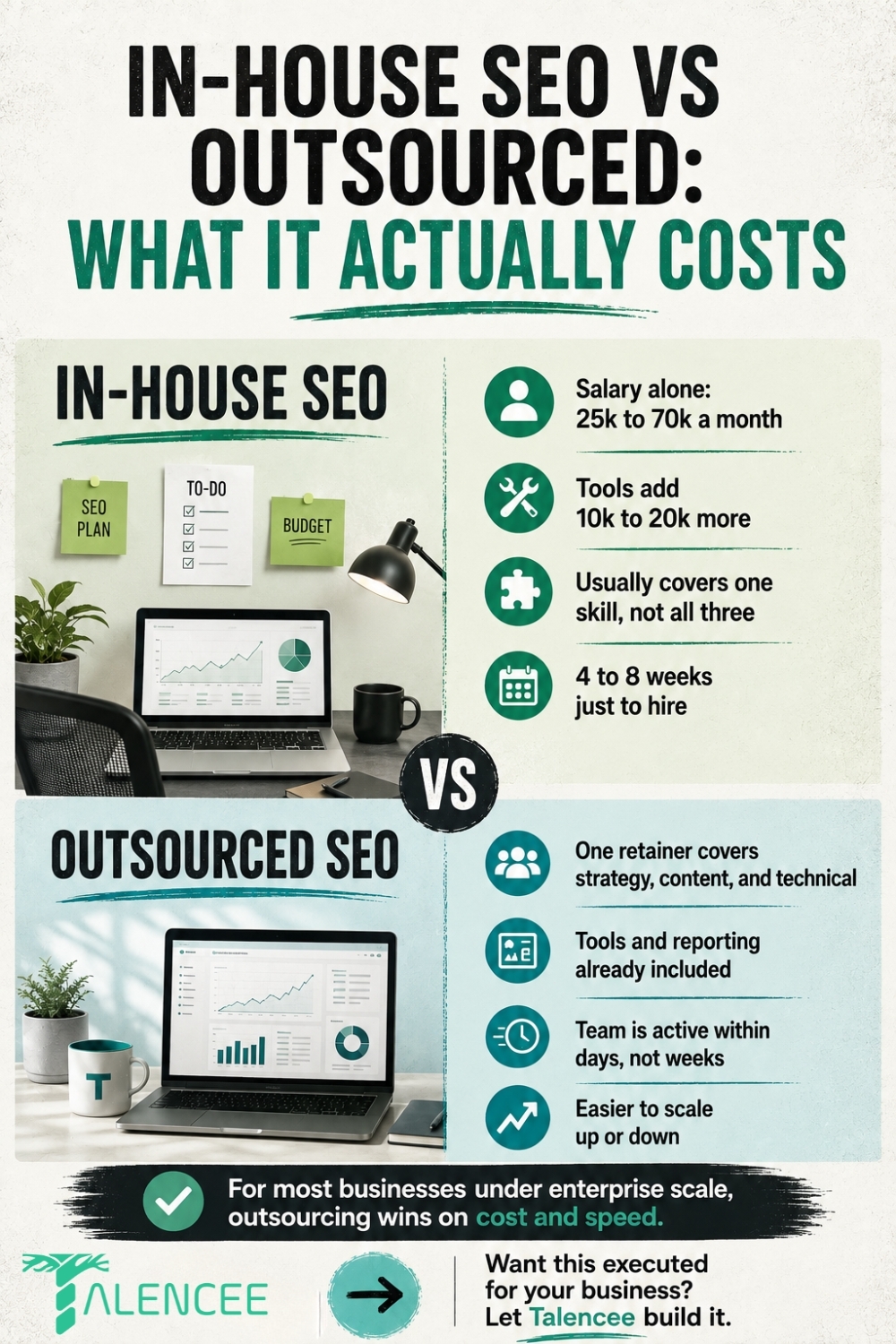
Here is the in-house SEO vs outsourced SEO comparison in one view.
Factor | In-house | Outsourced |
Typical monthly cost | About ₹25,000 to ₹2,00,000 or more, depending on seniority and team size | A fixed retainer, often comparable to or lower than a full in-house team |
Skill coverage | Usually one specialty per hire | Strategy, content and technical work bundled together |
Tool costs | About ₹11,000 to ₹22,000 or more per tool, per month | Usually included in the retainer |
Time to start | Often four to eight weeks to hire and onboard | Days to a couple of weeks |
Day-to-day control | Full control | Shared, depends on the agency's communication |
Risk if a person leaves | You restart hiring | The agency reassigns someone |
Scalability | Slow, since you hire or let go of people | Easier to scale up or down |
When In-House Makes Sense
In-house SEO vs outsourced SEO is not a contest with one winner. In-house is the better choice when:
• You run SEO across many products or markets. A dedicated in-house team compounds its knowledge over time.
• SEO must sit inside daily engineering or product work. Close contact with developers helps.
• You already have senior marketing leadership. Someone must manage and judge the work.
• Long-term control matters more than short-term cost. You own the knowledge, the process and the team.
• Your budget supports a full team. One lone generalist is often a weak setup.
When Outsourcing Makes Sense
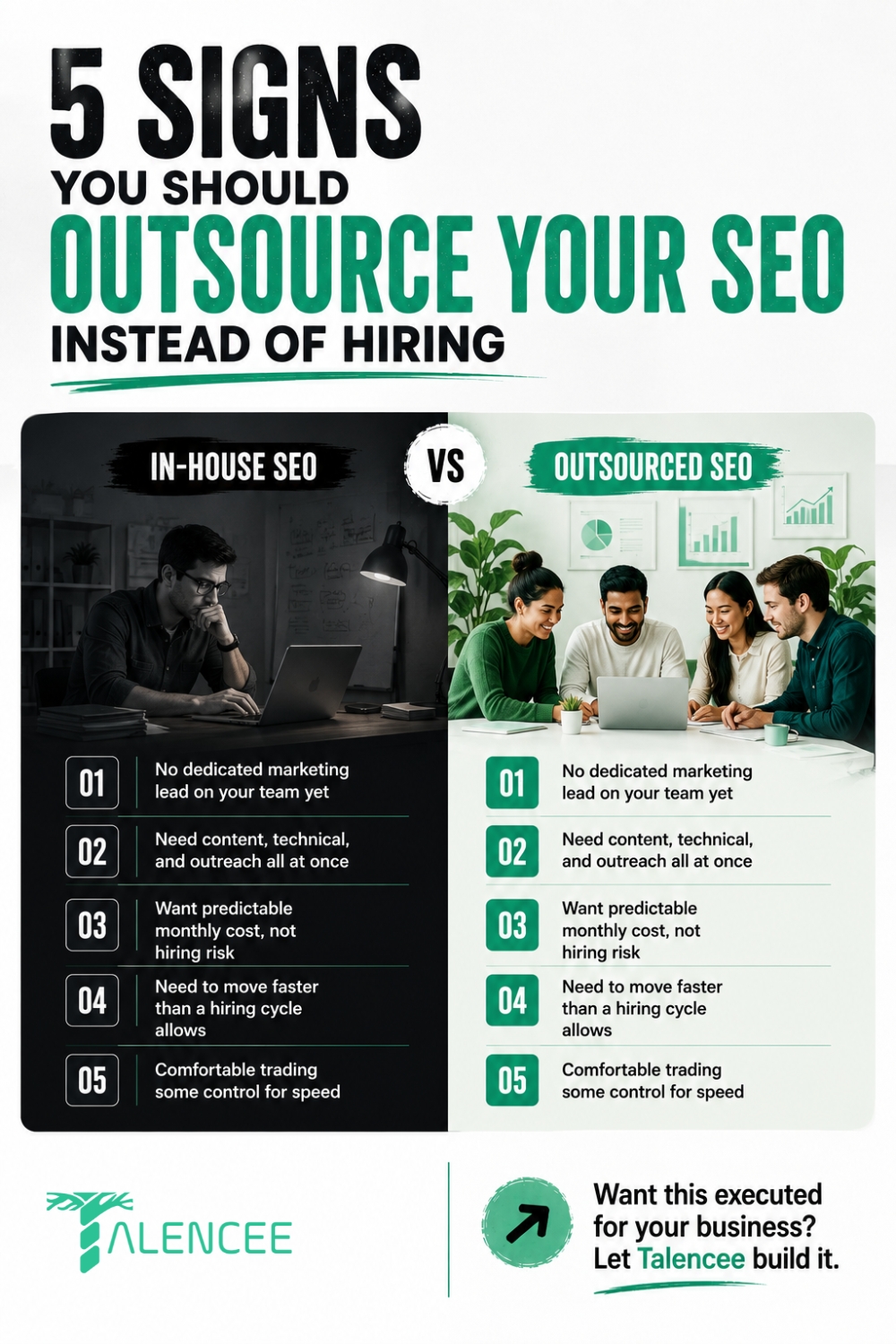
In the in-house SEO vs outsourced SEO decision, outsourcing is the better fit when:
• You have no dedicated marketing lead. Nobody in-house could manage or judge an SEO hire.
• You need content, technical and outreach work together. One hire rarely covers all three.
• You want a predictable monthly cost. A retainer avoids surprise hiring and tool bills.
• You need to start faster than a hiring cycle allows. Days beat weeks.
• You are happy to trade some control for speed. Regular reports and calls can replace daily oversight.
The Hybrid Model: Your Own Owner Plus an Outside Team
The in-house SEO vs outsourced SEO choice is not all or nothing. A common middle path is one in-house marketing owner who manages an outside SEO team. The owner keeps strategic control and the outside team handles execution and specialist tools.
Task | Best owner |
Business goals and priorities | In-house |
Brand voice and final approval | In-house |
Keyword research and content planning | Outside team |
Technical audits and fixes | Outside team, with your developer's help |
Writing and updating content | Outside team, with in-house review |
Link and mention building | Outside team |
Monthly reporting | Outside team, reviewed by in-house |
Clear handoffs prevent duplicated work. If you already have one generalist marketer, this model often works well, because that person gets expert support instead of trying to master every SEO skill.
In-House SEO vs Outsourced SEO by Business Type
Business type | Usually leans toward | Why |
Local business such as a clinic, restaurant or shop | Outsourced | Needs focused local work, not a full-time team. See our guide to local business SEO |
Early-stage startup | Outsourced or hybrid | Limited budget and no marketing lead yet |
Small e-commerce store | Outsourced | Needs content, technical and product page work together |
B2B services firm | Outsourced or hybrid | Needs steady content and authority building |
Funded company with a marketing team | Hybrid | Keeps strategy in-house, adds specialists |
Large enterprise with many markets | In-house, often with specialist help | Scale justifies a full team |
Risks to Watch in Each Option
Every option in the in-house SEO vs outsourced SEO debate has downsides. Knowing them helps you manage them.
Risks of in-house SEO
• Single point of failure. If your one specialist leaves, SEO stops.
• Skill gaps. One hire cannot be an expert in everything.
• Isolation. A lone specialist may lack peers, fresh ideas or benchmarks.
• Hidden tool costs. The bill grows as you add platforms.
• Management gap. Without senior SEO knowledge, nobody can judge the work.
Risks of outsourced SEO
• Wrong partner. Quality varies a lot from one provider to the next.
• Poor communication. Slow replies or vague reports waste time.
• Risky tactics. Some providers buy links or use shortcuts that can harm your site. Google's spam policies explain what to avoid.
• Lock-in. Long contracts and unclear ownership of accounts and content cause trouble later.
• Over-promising. Guarantees of rankings are a warning sign.
How to Vet an Outside SEO Team Before You Sign
If outsourcing looks like the right fit, check the provider carefully. Google's own guidance on whether you need an SEO is a good starting point. It says that no one can guarantee a number one ranking on Google, and that you stay responsible for what any company you hire does on your behalf.
Use this checklist:
1. Ask what work they will do. You should hear specific tasks, not general promises.
2. Ask how they measure success. Look for traffic, leads and revenue, not only rankings.
3. Check their interest in your business. Good providers ask about your customers, sales process and goals.
4. Ask for relevant examples. One case from your industry is worth more than a page of logos.
5. Insist on access. You should own your analytics, Search Console and any accounts they set up.
6. Read the contract. Check the term, notice period and who owns the content.
7. Start with a short scope. Three months with clear goals shows how the team works.
Red flags
• They guarantee a number one ranking or a fixed timeline for page one.
• They offer to buy links or use private networks.
• They send unsolicited emails promising quick results.
• They will not explain their methods.
• They refuse to give you access to reports and accounts.
• They lock you into a long contract with no exit.
How Fast Does SEO Work Either Way?
Neither side of the in-house SEO vs outsourced SEO choice makes SEO instant. Search results usually take several months to move, however you staff the work. Google also notes that making an SEO's recommended changes takes time and effort on your side, so you need some internal capacity in either case.
The difference is the starting line. With an in-house hire, you wait for recruitment and onboarding before real work begins. With an outside team, work usually starts within days or a couple of weeks. Over a twelve-month plan, that gap can matter, especially for a young site that needs foundations built early.
A Six-Question Scorecard to Decide
Use this scorecard for your in-house SEO vs outsourced SEO decision. Answer honestly, and the column with more answers is your likely direction.
Question | Leans in-house if... | Leans outsourced if... |
Do you have senior marketing leadership to manage SEO? | Yes | No |
Do you need several SEO skills at once? | No, one skill is enough | Yes, content, technical and outreach together |
How fast do you need to start? | Can wait two months | Need to start within weeks |
How important is daily control? | Essential | Regular reports are enough |
Is your budget fixed and monthly? | Can fund a team and tools | Prefer one predictable fee |
How many products or markets do you run? | Many, with constant SEO needs | One or a few |
If your answers are mixed, the hybrid model is usually the safest choice.
How to Measure SEO Success
Whichever route you pick, measure the same things. Google's Search Console performance report shows clicks, impressions and queries for free. Track:
• Organic clicks and impressions over time
• Non-branded traffic, meaning visits from people who do not already know your name
• Rankings for your priority keywords
• Leads, calls and sales from organic search
• Conversion rate of organic visitors
• Technical health, such as indexing problems and site speed
Review these monthly. Compare the results with what you pay, whether that is salary and tools or a retainer.
Common Mistakes in the In-House vs Outsourced SEO Decision
• Comparing one salary with a full retainer. One person is not the same as a team.
• Ignoring tool costs. They are real and recurring.
• Forgetting management time. Someone has to guide and review the work.
• Choosing on price alone. The cheapest option often leaves out content or technical work.
• Expecting quick rankings. SEO compounds over months.
• Giving up control completely. Even with an outside team, keep goals, approvals and access in your hands.
Frequently Asked Questions
In-house SEO vs outsourced SEO: which is cheaper?
For most small and mid-sized businesses, outsourced SEO is cheaper, because one fee covers strategy, content, technical work and tools. In-house SEO tends to win on cost only for large companies that need a full team running across many markets.
How much does it cost to outsource SEO in India?
Retainers vary by scope, city and agency size, so there is no single price. Many fall below the combined cost of hiring even one mid-level specialist plus tools, especially for businesses that need several skills covered at once. Collect written quotes and compare what each includes.
Is in-house SEO or outsourced SEO better for a small business?
For most small businesses, outsourced SEO is the better fit, because it covers several skills for one predictable fee and starts faster. In-house starts to make sense when SEO becomes a large, constant workload.
Can I do both, in-house and outsourced?
Yes. A common hybrid is one in-house marketing owner who manages an outsourced SEO team. This keeps strategy in-house while the outside team handles execution and specialist tools.
What if I already have one in-house marketer? Should I still outsource SEO?
Often yes, if that marketer is a generalist rather than an SEO specialist. Outsourcing technical and content-heavy SEO work frees your in-house person to focus on strategy and other channels.
How do I split ownership between an in-house person and an outsourced team?
Give the in-house person ownership of strategy, brand voice and final approval. Let the outside team own execution, research and reporting. Clear handoffs prevent duplicated work.
Is outsourcing SEO more expensive in the long run?
Rarely, for businesses below enterprise scale. Costs tend to tip in favour of in-house only when you need a full multi-person team running continuously across several markets or product lines.
How long does SEO take to work?
Usually several months, whichever option you choose. The timeline depends on your site, your competition and how much work gets done. Be careful with any provider who promises a fast, guaranteed ranking.
What should I check before hiring an outside SEO team?
Ask what work they will do, how they will measure success, who owns the accounts and content, and what the contract terms are. Avoid anyone who guarantees rankings or offers to buy links.
Conclusion
In-house SEO vs outsourced SEO comes down to a few honest questions: how many skills you need, how fast you need to start, how much control you want and how large your budget is. For most small and mid-sized businesses, outsourcing covers more skills for a predictable fee and starts sooner. For large companies with many markets and a senior marketing team, in-house becomes the stronger choice. If you are somewhere in between, a hybrid model often works best.
Comparing the real numbers usually settles this faster than most owners expect. Add up salaries, tools, hiring time and management effort, then compare the total with written quotes. If outsourcing looks like the better fit for where you are right now, see what our outsourced SEO team includes, or contact us to talk through your goals.
Sources and Further Reading
• Skillfloor, SEO Specialist Salary Guide, 2026. Salary bands by experience level.
• PW Skills, SEO Specialist Salary. Salary ranges by role.
• Online Amrita, SEO Salary Overview, 2026. Monthly salary estimates drawing on Glassdoor data.
• Ahrefs, official pricing page. Check current plans and per-seat charges.
• Semrush, official pricing page. Check current plans and per-seat charges.
• Google Search Central, Do you need an SEO?. Guidance on hiring an SEO and on guarantees.
• Google Search Central, spam policies. Practices that can harm a site's visibility.
Google Search Console Help, Performance report. Measuring clicks, impressions and queries.